
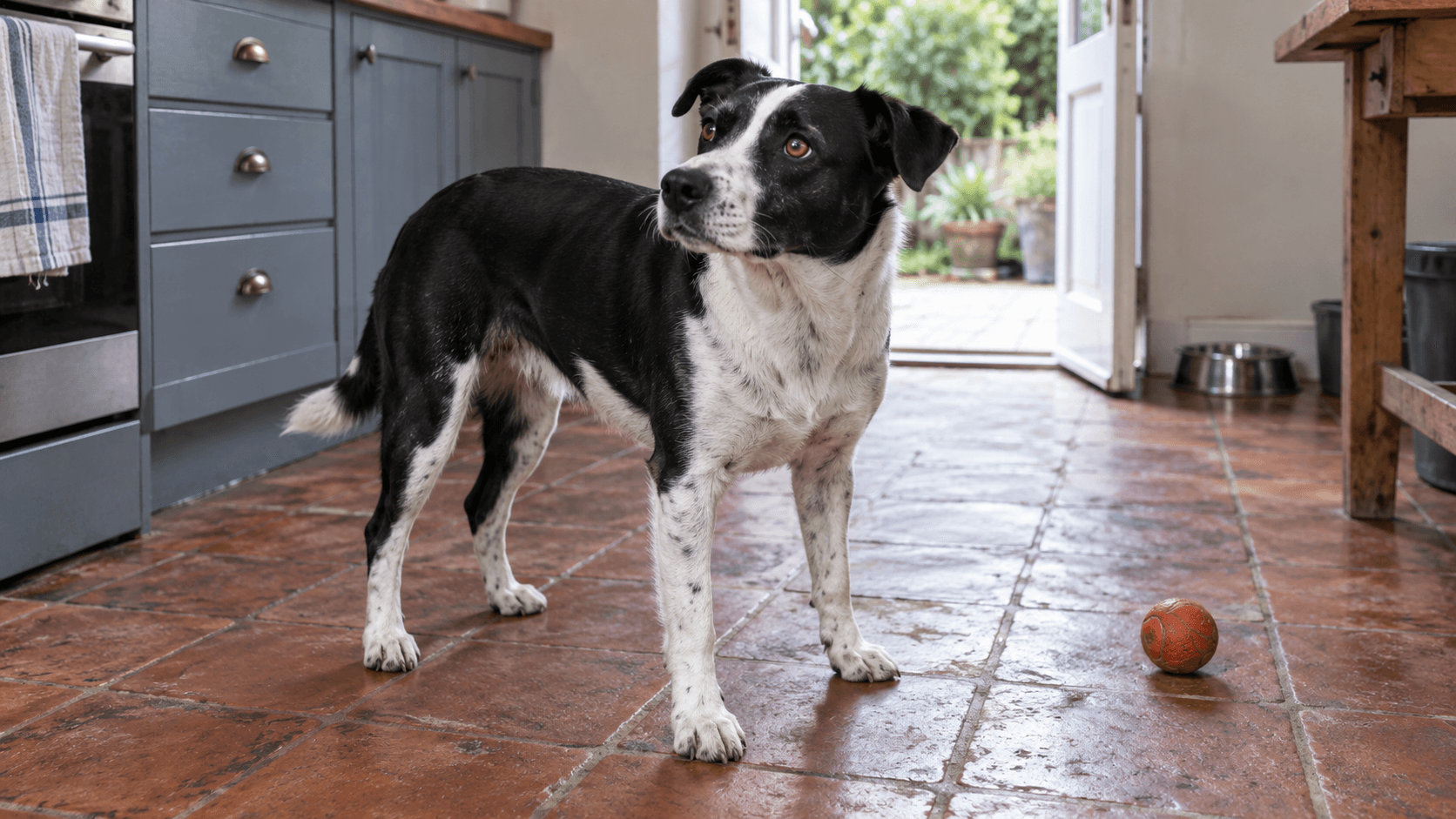
The walk is over, the food bowl is empty, and your dog is standing beside you with a shoe. It is tempting to translate the moment into one simple message: “I’m bored.” Sometimes, the day really does need more opportunities to explore and play. But a chewed shoe cannot tell you whether your dog needs an activity, a bathroom break, help feeling safe, or a veterinary appointment.
Boredom is a possibility to investigate, not a diagnosis to make from one behavior. The useful question is what has changed, when the behavior happens, and how your dog responds when their needs are met.
Possible signs of boredom in dogs
A dog whose day offers little choice may repeatedly seek interaction, investigate household objects, or struggle to settle. These observations can prompt a closer look at the routine. They do not establish the cause. Chewing is also normal canine behavior; barking may relate to something outside; restlessness can reflect discomfort or distress.
Environmental enrichment means providing meaningful opportunities to use normal abilities, including sniffing, exploring, learning, and interacting. Ohio State’s veterinary guidance emphasizes that an activity must actually interest the dog and should not frighten them. A room full of unused toys does not automatically meet that goal. [1]
Think about the difference between owning a bookshelf and finding a book you want to read. The same practical distinction applies here: access matters, but so do preference, ability, and the chance to participate successfully.
Look for patterns before buying something
Keep a brief record during ordinary routines, including comfortable periods. This is an observation aid, not a validated boredom test. A concerning change should not wait while you finish a log. If the pattern involves time alone, also review your dog’s workday care routine.
| Field | What to write |
|---|---|
| Time and context | Date, location, who was present, and whether you were home or away. Include relevant meals, toileting opportunities, walks, rest, or unusual noise. |
| Immediately before | The observable event: a van stopped, you picked up keys, someone approached, or the dog rose from bed. |
| Behavior | What the dog did and roughly how long it lasted, if known. Include pacing, drooling, movement changes, or other accompanying signs. |
| Immediately after | What changed in the surroundings, what you did, and what the dog did next. Record whether they settled or continued. |
| Compared with usual | New, more frequent, or familiar? Note changes in appetite, sleep, walking, interaction, or other normal activities. |
Hypothetical completed entry: Tuesday, 10:15 a.m., living room; owner home. A delivery van stopped outside. Dog stood at the window and barked for about two minutes. After the van left, the dog walked to bed and lay down. This has happened around several deliveries; appetite and the morning walk appeared usual. Next step: look at the window-related pattern and ways to offer a quieter resting area, rather than assuming the dog needs a harder food toy.
A different hypothetical entry, “paced, drooled, and scratched the door during my departure,” would raise a different question. A recording from an ordinary absence can help a veterinarian assess that pattern. Do not prolong an upsetting absence or recreate distress to collect evidence.
Record comfortable periods too: “chose to sniff on the walk, then rested at home” gives you a baseline. Neither one difficult episode nor one comfortable period establishes the cause of a behavior change.
Boredom, separation distress, or a health problem?
Separation-related distress. Destruction, vocalizing, and toileting during absences may occur with separation anxiety or other problems associated with being alone. Timing and accompanying signs matter. A food toy is not a reliable treatment for a dog who is panicking. Some distressed dogs will not eat the food it contains. Discuss recordings and your dog’s history with your veterinarian. [2]
Pain or another health problem. A dog who seems restless may have trouble getting comfortable. A dog who seems uninterested may be avoiding movement. Changes in mobility, sleep, interaction, appetite, or normal activities deserve attention, especially when they are new. Veterinary pain assessment considers these changes together; it does not depend on a dog crying out. [3]
A need for less stimulation. If the difficult moments follow a crowded outing, a noisy household, or repeated unwanted handling, adding a more demanding game may miss the problem. Consider whether your dog has a quiet place and the freedom to disengage. This is a practical question about the situation, not proof of a particular emotional state.
Seek veterinary advice for persistent or sudden behavior changes. Breathing difficulty, collapse, a suspected swallowed object, or obvious severe pain calls for urgent care rather than an enrichment experiment.
Use the pattern to choose the next step
- Mostly during departures: Discuss the timing, accompanying signs, and any safe recording with your veterinarian. Do not rely on a food toy to treat panic.
- Mostly around a visible or audible trigger: Consider whether reducing exposure or providing a quieter resting choice makes the situation easier. Do not repeatedly present the trigger to test your explanation.
- Alongside changed movement, appetite, sleep, or touch tolerance: Arrange veterinary advice rather than simply increasing exercise.
- An otherwise comfortable dog with few activity choices: Try one modest opportunity below and note voluntary participation and the response afterward.
These routes can overlap. If a change is sudden, persistent, or worrying, bring the record to your veterinary team rather than choosing a label yourself.
Try a small, observable change
Choose one opportunity your dog already seems to enjoy. Let a suitable walk include unhurried sniffing. Practice a familiar reward-based skill for a short session. Offer an easy food activity while you are present, using food from the normal daily allowance.
Start below the level that leads to frustration. If your dog disengages, damages the item, or appears uncomfortable, pause and reconsider the activity. Success is not how long you can keep the dog occupied; it is whether the experience seems comfortable and worthwhile.
Keep other parts of the day reasonably consistent so you can judge the change. Ask: Did my dog choose to participate? Could they succeed? Did they settle comfortably afterward? Would a simpler version work better?
What research can tell us
Enrichment research supports taking an animal’s environment seriously, but it does not turn a list of behaviors into a home diagnostic tool. In a 2023 shelter study involving 83 dogs, different enrichment conditions produced different changes in posture and vocalization during kennel cleaning. An intervention that affected one measured behavior was not necessarily the strongest for another. [4]
That study concerned an acute shelter stressor. It cannot tell us that a particular toy cures boredom in a family home, and it is not a reason to experiment with scented products around your dog. Its useful lesson is narrower: context and the outcome being measured matter.
You do not need to turn every waking hour into entertainment. Start with a routine your dog can comfortably live in, notice what they choose, and investigate changes instead of assigning blame. The shoe is a reason to pay attention, not the whole explanation.
Continue exploring
Sources
- The Ohio State University College of Veterinary Medicine, Indoor Pet Initiative. Environmental Enrichment for Dogs. Veterinary educational guidance; accessed September 12, 2026.
- VCA Animal Hospitals. Separation Anxiety in Dogs. Veterinary clinical guidance; used for signs and assessment, not as a stand-alone treatment protocol. Accessed September 12, 2026.
- American Animal Hospital Association. Chronic Pain Assessment in Dogs, 2022 AAHA Pain Management Guidelines for Dogs and Cats. Clinical guideline.
- Dare P, Strasser R. Ruff Morning? The Use of Environmental Enrichment during an Acute Stressor in Kenneled Shelter Dogs. Animals. 2023;13:1506. doi:10.3390/ani13091506. Shelter study; not a trial of boredom treatment in household dogs.