
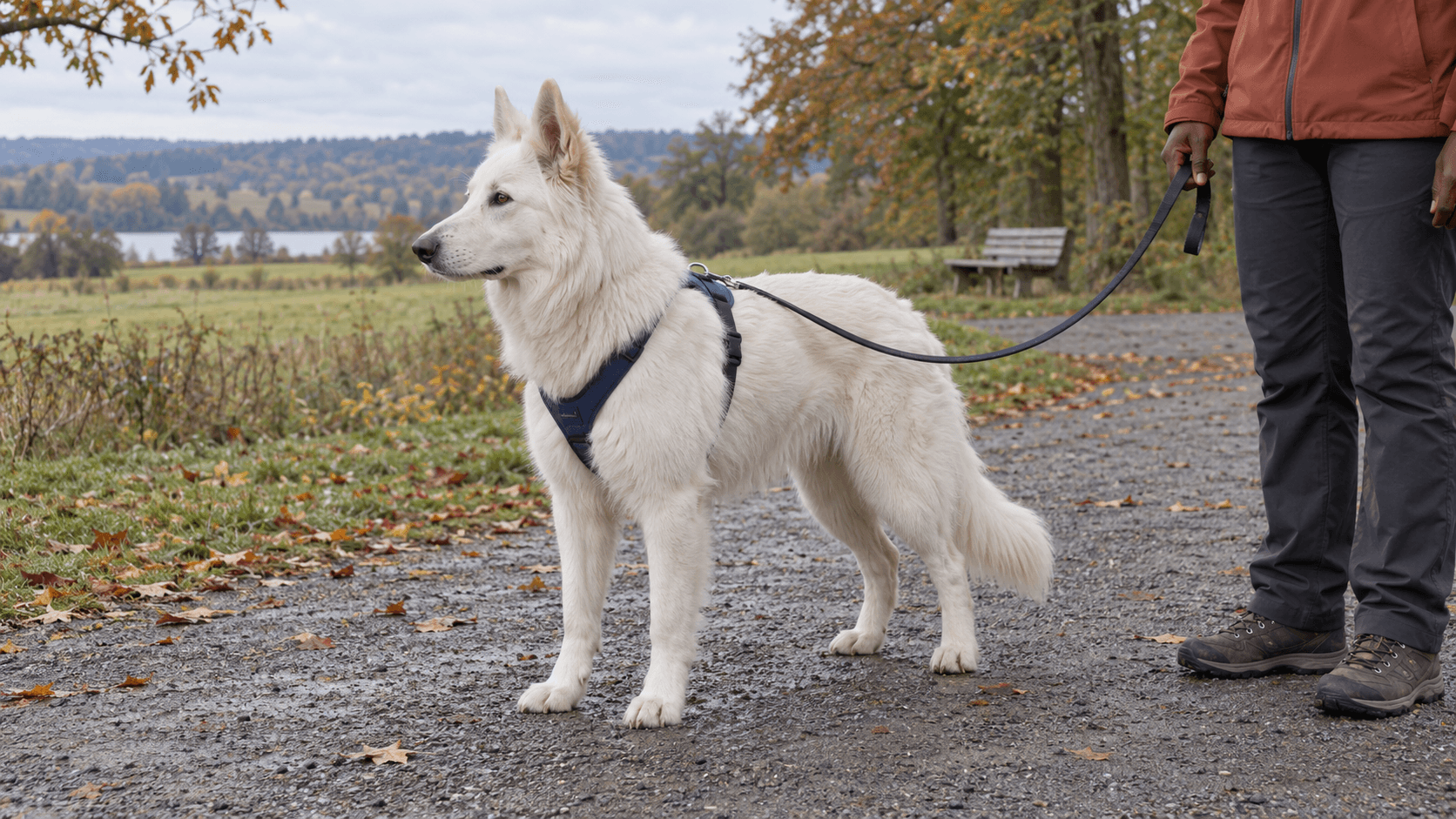
A dog turns their head away as someone reaches to pet them. The person moves closer, thinking the dog has not noticed. The dog becomes still. Nothing dramatic has happened, but this is already a moment worth respecting.
Reading body language is not about assigning a fixed translation to every tail movement. It is about noticing the whole dog, the situation, and what changes as an interaction continues. You do not need certainty about a dog’s feelings to give them more space.
How to read dog body language in context
A yawn after waking and a yawn during close handling occur in different situations. A dog can lick their lips around food or during an uncomfortable interaction. Raised hair can indicate arousal without telling you whether the dog is excited, fearful, or about to act aggressively.
VCA’s veterinary behavior guidance describes communication through posture, facial expression, movement, scent, and sound. It stresses that individual signals belong within a broader sequence rather than functioning as a precise spoken language. [1]
Before interpreting a signal, ask: What is approaching? Can the dog move away? Is someone leaning over them, holding them still, or reaching toward a valued object? Has the dog’s posture changed since the interaction began?
Possible stress signals to watch for
Signs that may accompany discomfort include turning away, lowering the body, pulling the ears back, repeated lip licking, avoiding contact, or moving away. A tense, motionless posture, fixed stare, growl, or snap demands a prompt change in the situation. Not every dog shows the same sequence, and escalation can be rapid. [1]
A wagging tail does not cancel the rest of the body. Likewise, a dog rolling onto their back is not always inviting a belly rub. Look at whether they are loose and actively seeking contact or tense, still, and trying to reduce the interaction.
Breed features, individual appearance, and prior experience can make signals easier or harder to see. You do not need to classify every detail before acting cautiously.
Respond by making the situation easier
Stop reaching, petting, or asking the dog to remain in an interaction they appear to avoid. Give them a clear route away. If you are walking, create distance from the trigger when you can do so safely. Do not increase the pressure by bringing another dog closer “to show there is nothing to fear.”
For familiar dogs who seek petting, you can pause briefly during contact and notice whether they approach for more or choose to leave. This is a practical way to offer choice, not a formal test or a guarantee against a bite. Never use it to test the tolerance of an unfamiliar or tense dog.
In a difficult moment, your job is not to prove that the dog is friendly. It is to reduce pressure and prevent escalation.
A visitor example: observe, pause, and make room
These are hypothetical situations, not photographs of assessed dogs or a sequence to recreate. The aim is to choose a safer response to what is happening, not to assign a fixed meaning to a single signal. Stop an unwanted interaction at the first sign of avoidance; do not wait for the next row.
| Situation and observation | Response |
|---|---|
| A visitor reaches over; the dog turns their head away or steps back. | Ask the visitor to stop reaching and allow space. Keep the route away clear. Do not follow the dog or use food to lure them back into reach. |
| During an interaction, the dog becomes tense and motionless, stares, growls, or snaps. | End the interaction and create distance or safe separation. Do not grab, corner, scold, or test the dog again. Keep children away and seek qualified help for the pattern. |
| A familiar dog voluntarily seeks contact with a familiar adult and remains loose; the adult pauses petting. | Allow the dog to leave. If they seek more contact, keep it brief and continue noticing the whole interaction. Approaching or wagging alone does not guarantee that further handling is safe. |
Plan before visitors arrive if there is a known difficulty: arrange a comfortable separate space or a suitable barrier, and tell visitors not to approach the dog there. Do not depend on a child to interpret signals or enforce the plan. If you cannot manage the situation safely, discuss it with your veterinarian before attempting another greeting.
A growl is a reason to change the situation
Do not punish a growl or try to overpower the dog. Avoiding punishment does not mean remaining in an unsafe situation; use distance, barriers, or safe separation as needed to protect people and animals. The American Veterinary Society of Animal Behavior recommends reward-based methods and advises against physical or psychological punishment in training and behavior modification. Its 2025 clarification reaffirms that position. [2]
If a dog stiffens or growls around food, a resting place, or an object, do not repeatedly take the item away to test the response. Arrange safe separation and seek qualified help. Keep children away from the situation; they should not be responsible for recognizing or managing the warning signs.
Reward-based work is not the same as luring a frightened dog into a situation they cannot tolerate. A behavior plan should fit the dog’s starting point and include management that prevents rehearsing dangerous encounters.
When the behavior is new, consider health
A dog who suddenly avoids touch, reacts when being lifted, or becomes reluctant to move may be experiencing discomfort. Chronic pain assessment includes changes in activity, behavior, and normal function; the absence of vocalizing does not rule pain out. [3]
Arrange a veterinary examination for a new or persistent behavior change. Tell the team what seems to trigger it, how recently it started, and whether sleep, appetite, walking, or other activities have changed. If recording is possible without provoking the behavior, a short video can help. Do not recreate a risky encounter for the camera. For an older dog, our guide to signs of pain in senior dogs explains which everyday changes to record.
Build a useful observation habit
Choose ordinary, low-pressure moments to learn your dog’s baseline: resting nearby, exploring a familiar route, or approaching someone they know. Notice the rhythm of movement and what your dog does when given a choice.
Then record difficult situations in concrete language. “Turned away when a visitor leaned over, then moved behind me” is more useful than “was being dramatic.” It gives a veterinarian or behavior professional something to investigate and gives you a situation you can manage differently next time.
Understanding body language will never give anyone perfect prediction. It can give you an earlier opportunity to respond. Often, the most helpful response is a small one: stop, make room, and let the dog decide whether to continue.
A short note to bring to a professional
- Situation: Who was present, what approached, and whether the dog had a clear way to leave.
- Observable change: Head, ears, posture, movement, and sound together; avoid writing only an interpretation such as “jealous.”
- Your response: What stopped or moved away, and what the dog did next. Do not repeat the interaction to see whether the result is consistent.
- Pattern and health: When this began, previous similar events, and any changes in appetite, sleep, movement, or touch tolerance.
Ask your veterinary team for help finding a qualified behavior professional who uses reward-based methods and will coordinate with the vet when health may be involved. Describe any growling, snapping, or bite history when arranging help so the visit can be planned safely. A video is optional and should come only from an ordinary situation that can be recorded without adding pressure or risk.
Continue exploring
Sources
- Horwitz D, Landsberg G, DePorter T, Joswich J. Canine Communication – Interpreting Dog Language. VCA Animal Hospitals/LifeLearn. Veterinary behavior guidance; accessed September 12, 2026.
- American Veterinary Society of Animal Behavior. Position Statements. See the 2021 Humane Dog Training statement (PDF) and the 2025 board clarification on the position-statements page. Links checked October 26, 2026.
- American Animal Hospital Association. Chronic Pain Assessment in Dogs. 2022 AAHA Pain Management Guidelines for Dogs and Cats.