
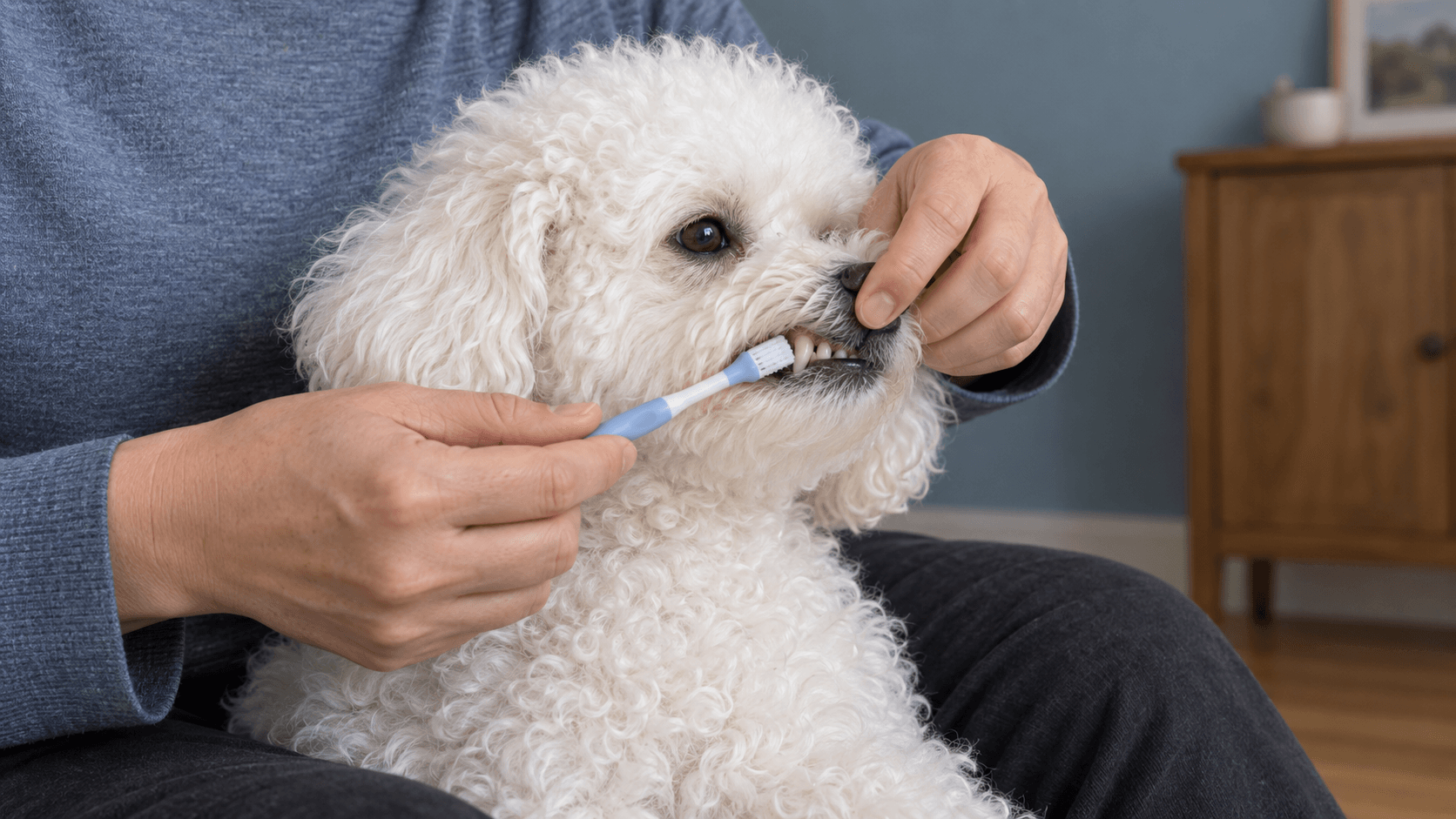
Bad breath is often treated as a normal part of living with a dog or cat. It is easy to make the joke and move on. But a mouth that smells different, hurts, or changes how an animal eats deserves attention.
Pet dental care has three distinct parts: finding and treating disease, controlling plaque at home, and checking whether the plan is working. A chew, a toothbrush, and a professional dental procedure do not all perform the same job.
Signs your dog or cat needs a dental examination
The AVMA recommends veterinary attention for signs such as broken teeth, altered chewing, dropping food, reduced appetite, bleeding, swelling, or pain around the mouth. Some animals also become irritable. Do not force open a painful mouth to inspect it yourself. [1]
A routine awake examination can identify concerns, but it cannot reveal every problem below the gumline. Ask your veterinarian what they can assess during the visit and whether a more complete dental evaluation is indicated.
If your pet is already uncomfortable, starting an ambitious brushing routine may be the wrong first step. Painful disease should be assessed before you ask the animal to accept repeated contact with the area.
What happens beyond the visible tooth surface?
Plaque accumulates on teeth, and mineralized deposits form tartar. Disease affecting the structures supporting the teeth can extend below the gumline, where home brushing cannot adequately evaluate or treat it. Veterinary dental care may involve probing, dental radiographs, cleaning, and treatment selected from the findings. [2]
That is why a tooth that looks cleaner is not necessarily a healthy tooth. Removing visible deposits without assessing the rest of the mouth can leave important disease unrecognized.
Cats also develop tooth resorption, in which tooth structure breaks down. Cornell describes it as a potentially painful condition that may require examination and radiographs to assess. It is not something a dental treat can diagnose or reverse. [3]
Why comprehensive veterinary dentistry requires anesthesia
General anesthesia allows a veterinary team to examine and treat the mouth while the animal remains still and the airway can be managed appropriately. It enables work that cannot be performed thoroughly and comfortably in a resisting, awake pet. [2]
Anesthesia has risks that require an individual assessment and monitoring plan. Ask how your pet’s health affects preparation, what monitoring will be used, and how pain will be addressed. A useful discussion weighs the proposed procedure and the consequences of leaving disease untreated.
The AVMA notes that anesthesia-free dental cleaning does not allow adequate inspection or cleaning below the gumline and is not recommended by the American Veterinary Dental College. It should not be presented as an equivalent substitute for a comprehensive veterinary dental procedure. [1]
Make brushing a skill your pet can learn
Once your veterinarian confirms that brushing is appropriate, ask for a demonstration. Use a toothbrush or tool suited to the animal and toothpaste intended for that species. Cornell specifically warns against human toothpaste for cats and advises gradual introduction, particularly when a cat is unfamiliar with handling around the mouth. [3]
Begin with a small, comfortable step. That might mean accepting a brief lip lift, investigating the product, or tolerating a moment of contact. Reward cooperation and stop before the interaction becomes a struggle. You do not need to reach the whole mouth in the first session.
Daily brushing is the ideal target for regular plaque control. If you cannot reach that point, discuss a realistic combination of options with your veterinarian rather than abandoning care altogether. Brushing maintains health; it does not remove the need for examinations or treat established disease on its own. [1]
What a VOHC dental product claim means
The Veterinary Oral Health Council reviews submitted evidence and awards its Seal of Acceptance for specified plaque and/or tartar-control claims; it does not test products itself. To check a claim, open the accepted-products list for dogs or cats, match the exact item and any listed size or formulation, and read whether acceptance covers plaque, tartar, or both. Do not assume that acceptance applies to every item from the same manufacturer. Note when you checked the list and ask your veterinarian whether that option suits your pet’s mouth and health needs. [4] [5]
That is more useful than a package simply saying “dental.” Still, acceptance is not proof that a product treats periodontal disease, suits every pet, or makes professional care unnecessary.
Before adding a chew or diet, check the appropriate species, size, directions, and your pet’s ability to use it safely. Include edible products in the feeding plan and discuss restrictions related to dental damage, swallowing behavior, or other medical conditions. This article does not rank individual products or claim to have tested them.
Keep a dental-care note for the next visit
Write down observations and the plan your clinic gives you. You do not need to force open your pet’s mouth to fill in a record.
- What changed: when you noticed altered chewing, dropped food, odor, bleeding, swelling, or resistance to handling. Record only what you actually saw.
- What the clinic found: the findings explained to you, any further assessment recommended, and questions still unanswered.
- Home-care instructions: whether brushing is appropriate, the demonstrated starting step, and the exact products and directions recommended for your pet.
- Follow-up: when to return and which changes should prompt a call sooner.
Call template: “My pet has [observed change], first noticed [when]. We currently use [home-care products or routine]. Should we arrange an examination before continuing that routine?” If handling is painful, report that rather than trying to obtain a closer look.
Plan the next check before leaving the clinic
Ask what was found, which home-care options are appropriate, and when the mouth should be reassessed. If a procedure is recommended, request an explanation of the proposed assessment and how treatment decisions will be discussed.
At home, watch for a return of odor, altered eating, bleeding, or resistance to previously comfortable handling. Contact the clinic when these occur rather than increasing brushing pressure or switching to a harder chew.
Dental care becomes more manageable when each part has a clear purpose. The brush helps with ongoing plaque control. The product claim tells you what evidence supports that item. The veterinary examination and procedure address questions you cannot answer by looking at the visible surface alone.
This article provides general education and does not replace an individual dental assessment.
Continue exploring
Sources
- American Veterinary Medical Association. Pet Dental Care. Professional guidance on warning signs, home care, and anesthesia-free cleaning; accessed September 12, 2026.
- American Animal Hospital Association. 2019 AAHA Dental Care Guidelines for Dogs and Cats. Clinical guideline. doi:10.5326/JAAHA-MS-6933.
- Cornell Feline Health Center. Feline Dental Disease. Veterinary guidance on gingivitis, periodontitis, resorption, and brushing; accessed September 12, 2026.
- Veterinary Oral Health Council. About the VOHC. Official explanation of evidence review and the Seal of Acceptance; checked October 27, 2026.
- Veterinary Oral Health Council. Accepted Products. Official product-specific plaque/tartar claims; checked September 12, 2026.