
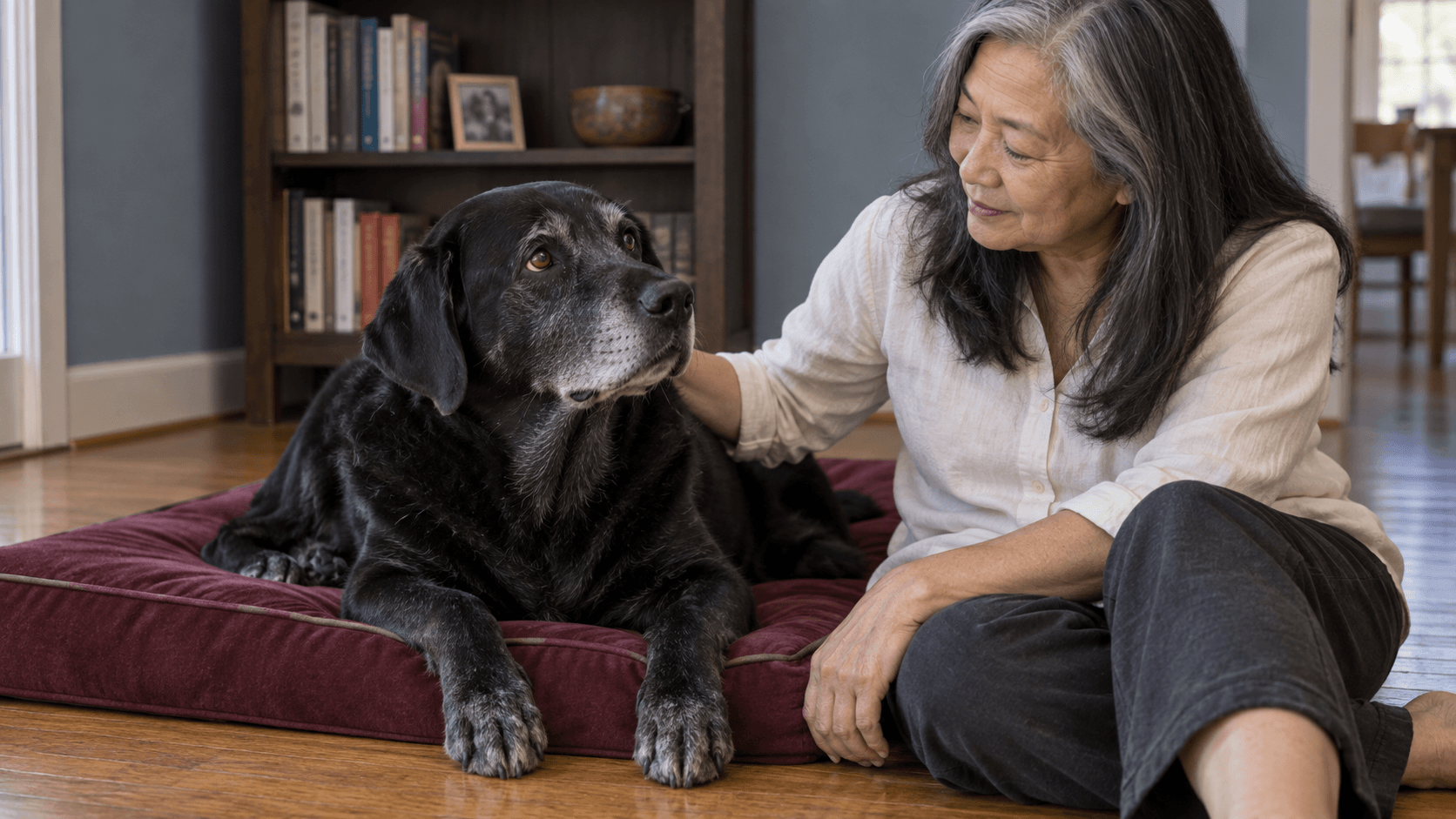
Your dog still greets you at the door, but the trip takes longer. They wait at the stairs they once climbed without thinking. A favorite walk ends a little earlier, and you find yourself saying, “They’re just getting older.”
Age is part of the picture. It is not an explanation for every change. A senior dog who moves, sleeps, eats, or interacts differently deserves an assessment of what has changed and why. Pain is one possibility, and it is not the only one.
Noticing these details is not pessimism. It is a chance to make the next stage of your dog’s life more comfortable.
Possible signs of pain in a senior dog
Does your dog pause before getting up, choose a different route around the house, hesitate on a slippery floor, or stop joining you on a favorite resting spot? Do they seem less comfortable when touched or repositioned? These may be more informative than waiting for a yelp. For practical observation tips, read our guide to dog body language and stress signals.
AAHA’s senior-care guidance notes that chronic pain can produce subtle behavioral changes that owners may attribute to normal aging. It encourages observing how the animal moves and interacts with the home environment. [1]
Avoid turning these observations into a diagnosis. A dog may hesitate at stairs because of pain, weakness, impaired vision, fear after slipping, or several factors together. The pattern is a reason to investigate, not a way to decide on medication yourself.
Pain can be present without obvious limping
Changes may involve willingness to move, sleep quality, posture, or ordinary activities rather than a single visibly sore leg. Veterinary assessment of chronic pain combines the owner’s observations with examination and, when indicated, further tests. [2]
Some questionnaires help track mobility and function over time. These questionnaires support assessment and monitoring; they do not replace an examination or establish an arthritis diagnosis. An individual dog’s progress is more meaningful than comparing them with a stranger’s checklist result.
This is also why an X-ray is not the entire answer. AAHA notes that radiographic changes and pain on examination do not always correlate closely. Findings need to be interpreted alongside the dog’s history and function. [2]
Other health problems that can cause slowing down
AAHA’s senior evaluation guidance includes eating, drinking, toileting, grooming, vision, hearing, movement, and behavior in the history. It also considers conditions beyond the joints, including metabolic, cardiac, and other disease. [3]
Tell your veterinarian about increased thirst, appetite or weight changes, coughing, altered breathing, new toileting accidents, or changes in awareness. A mobility complaint can be the first part of a broader conversation.
Bring a complete list of medications, supplements, oils, and nonprescription products. Their names, amounts, and timing matter because products can interact. Something described as natural should not be left off the list.
Help your veterinarian assess the changes
Record a few ordinary activities without asking your dog to do anything painful: getting up from their usual bed, walking along a familiar nonslip route, or turning in a comfortable space. Avoid staging a difficult jump or staircase attempt just to show the problem.
Keep a brief note of when the change began, whether it varies through the day, and what your dog has stopped doing. “No longer comes to the kitchen when food is prepared” gives the veterinarian a concrete change to explore.
Choose two or three activities that matter to your dog’s daily life. These can become useful reference points after a treatment or environmental change. The aim is to compare your dog with their own recent experience, using the same activity when possible.
Ask the clinic ahead of time about accessible entry, a nonslip examination surface, or assistance for a dog who cannot get into the car comfortably. Planning the visit can reduce unnecessary strain.
Bring a short change record to the appointment
Use the same ordinary activities as reference points, without making your dog repeat a painful movement for the record.
- Change first noticed: date or approximate period, and whether the change was sudden or gradual.
- Activity: getting up, a familiar walk, resting, or joining the family. Write what was usual and what happens now.
- Pattern: time of day, surface, and whether the change is consistent or varies.
- Other changes: eating, drinking, toileting, sleep, breathing, or interaction. Include a video only if you can record an ordinary activity comfortably.
- Current products: names, amounts, and timing of medications, supplements, and nonprescription products.
Call template: “Since [when], my dog has changed from [usual activity] to [what I observe now]. I have also noticed [other changes]. How should we arrange an assessment, and can you help with access to the clinic?” Do not postpone urgent care to complete a log.
Make the house easier to use
Home modifications can support comfort while the medical plan is developed. AAHA includes better footing, suitable ramps, appropriate beds, and attention to hazards when vision or hearing is limited. [1]
Start with the route used most often: bed to water, resting area to the door, or the place where your dog joins the family. Secure nonslip runners so they do not slide or curl. Keep needed resources accessible and prevent unsupervised access to difficult stairs or other hazards.
A ramp also needs a suitable slope, surface, and introduction. Do not pull a reluctant dog up it. Ask a veterinary rehabilitation professional or your veterinarian for help choosing and using mobility aids, especially if lifting or supporting the dog is difficult.
These changes should make daily tasks easier. They do not tell you which disease is present, and they should not become a reason to postpone an examination.
Treatment should have a goal you can observe
A veterinary plan may combine medication, weight management, appropriate activity, rehabilitation, and environmental changes. The combination depends on the diagnosis and the dog’s other health needs. There is no single supplement or exercise plan that fits every senior dog. [1]
Ask what improvement is expected, when it should be assessed, and what adverse effects to watch for. Revisit the reference activities you recorded: Is getting up easier? Is rest more comfortable? Is the dog choosing to participate again?
Do not give human pain relievers or another pet’s leftover medicine unless your veterinarian explicitly directs you. The FDA explains that pain medicines can have serious adverse effects and need appropriate selection and monitoring. Report new signs after treatment and follow the clinic’s instructions about stopping or changing a product. [4]
When to seek urgent help
Sudden inability to stand, collapse, trouble breathing, a major injury, or severe ongoing pain needs urgent veterinary assessment. Do not assume an abrupt change is another stage of aging.
For gradual changes, make an appointment rather than waiting for the dog to stop participating altogether. A dog who still enjoys part of their day may nevertheless have a problem worth treating.
You know many of your dog’s habits better than anyone else. Those familiar details, such as the preferred path, the usual greeting, and the comfortable sleeping position, can help the veterinary team understand what has become harder. Paying attention to them is one way to keep caring for the dog you know as their needs change.
This article provides general education and does not diagnose pain or recommend medication for an individual dog.
Continue exploring
Sources
- American Animal Hospital Association. Pain Management, 2023 AAHA Senior Care Guidelines for Dogs and Cats. Clinical consensus and evidence-informed guidance; includes disclosed organizational sponsorship.
- American Animal Hospital Association. Chronic Pain Assessment in Dogs, 2022 AAHA Pain Management Guidelines for Dogs and Cats. Guidance on owner reports, clinical assessment, and the limits of individual measures.
- American Animal Hospital Association. Evaluating the Healthy Senior Pet, 2023 AAHA Senior Care Guidelines for Dogs and Cats. Veterinary history, examination, and investigation framework.
- U.S. Food and Drug Administration. Get the Facts about Pain Relievers for Pets. Government medication-safety guidance; accessed September 12, 2026.