
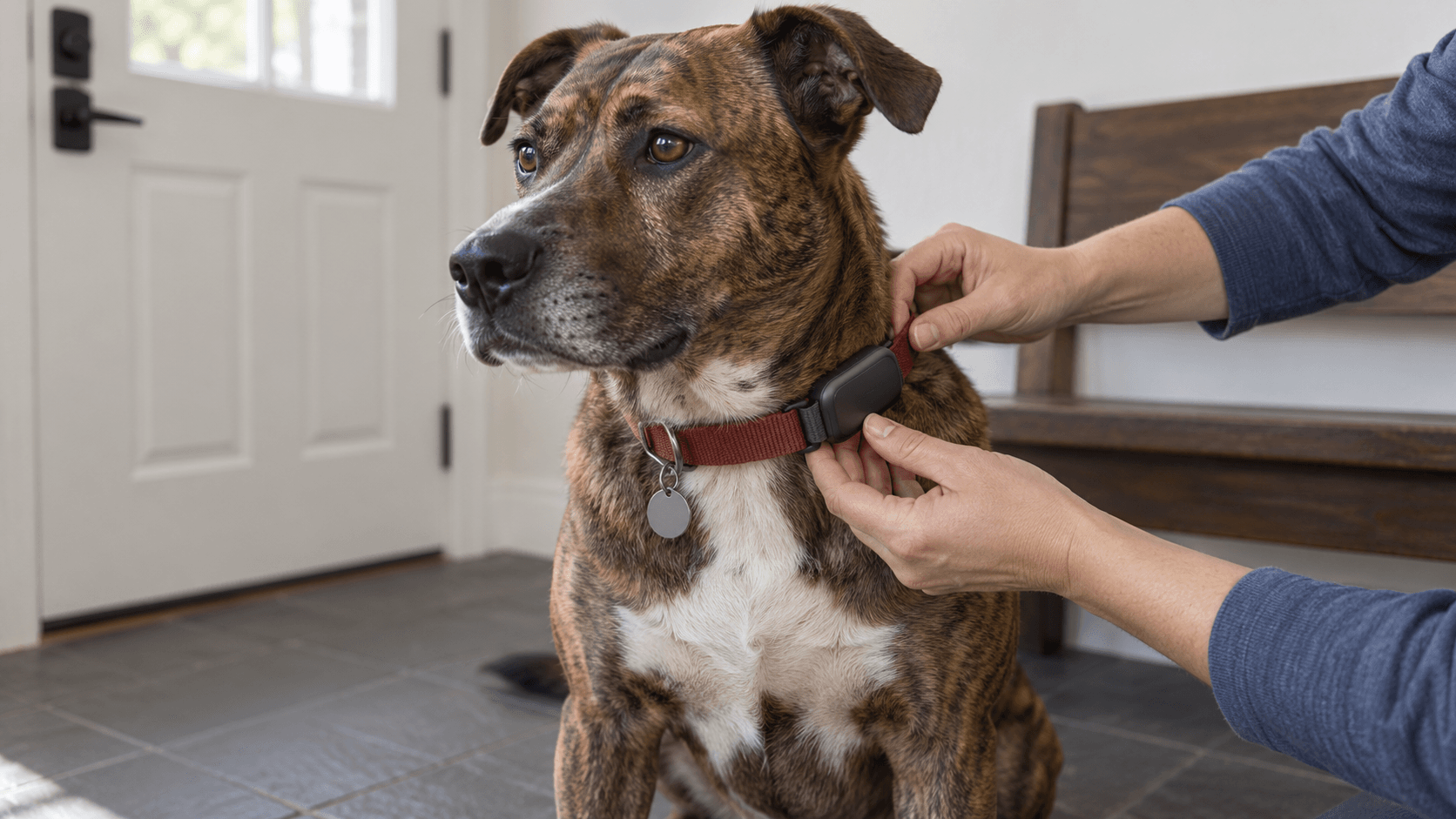
If your pet slips through an open gate, a microchip will not put a moving dot on your phone. If someone finds your pet after their tracking collar comes off, a GPS subscription will not identify them at the veterinary clinic.
A microchip and a GPS tracker solve different problems. One can help identify an animal who has been found. The other may help you locate a device attached to the animal. They can complement each other, but neither guarantees a reunion.
GPS trackers vs. microchips: key differences
| Question | Implanted identification microchip | Pet GPS tracker |
|---|---|---|
| What does it do? | Provides an identification number when scanned | Estimates location and communicates it through the device’s supported system |
| Does it show live location? | No | Some models provide frequent location updates under suitable conditions |
| Does it need charging? | Standard identification chips do not have a battery | The tracker has a power source that must be maintained |
| What must you keep current? | Registration and contact details | Charging, service plan where required, app access, and device attachment |
| What is a major limitation? | The pet must be found and the chip detected and linked to usable records | Coverage, power, attachment, and update conditions can limit information |
The microchip information follows AVMA guidance. Tracker features are model-dependent, so specifications should be checked for the exact device being considered. [1]
How pet microchips and registration work
The AVMA explains that a scanner activates the chip and reads its identification number. The number can be used to locate the appropriate registry, which can help contact the owner. The chip itself is not a GPS transmitter. [1]
Confirm registration in your name, update changed contact details, and ask your veterinarian to check the chip during routine care.
AAHA’s lookup tool identifies participating registries, rather than registering pets or displaying owners’ contact details. [3]
Keep the chip number somewhere you can access away from home. A short maintenance task now is easier than trying to reconstruct the information during a search.
A tracker needs more than satellites
GPS provides positioning information to a receiver; it does not send that receiver’s location to your phone. A pet tracker needs a separate, supported communication system to deliver its location. Many consumer models use cellular service, while other systems may use a dedicated radio receiver. Check the technology and requirements of the exact model. [2]
Check coverage where you actually walk or travel and read what happens without a network connection. Power, device attachment, update frequency, and any required service plan also affect the information you receive. Satellite positioning and a current location report reaching you are separate requirements.
Read the update, not just the dot
When testing a device, look for the time of the last update, whether the location is current or historical, and any uncertainty shown by the app. Compare what you see with a known location while your pet remains safely contained or on leash.
This is a practical familiarization exercise, not a way to certify performance in every emergency. A location estimate is not proof that the animal is still there, and the device can remain in one place if it becomes detached.
Do not test escape alerts by allowing an animal to escape. Walk through the feature safely with the device and a controlled setup, following its instructions.
Keep a tracker check beside your ID records
Use a familiar, controlled outing to learn what the app displays. Keep your pet safely contained or on leash throughout. Record:
- Known place and time: where the device actually is and when you are checking it.
- Displayed report: the map location, last-update time, and any uncertainty or connection warning.
- Device conditions: battery level, attachment, and any required service status.
- Identification backup: microchip number, registry, date you checked the registered contact details, and current tag information.
Hypothetical example: you open the app at 2:15 p.m., but the location report is stamped 1:40 p.m. That report is 35 minutes old. It describes a reported device location at the earlier time, not proof of your pet’s current location. Check the app’s status information and the device instructions rather than treating the dot as live.
This record is for familiarization and upkeep. It is not a performance certification or a reason to test the device by letting a pet escape.
Check the total cost and the physical fit
Before purchase, write down the device cost, required service plan, renewal period, cancellation terms, return window, and replacement accessories. Check which features still work if the plan expires. If you travel, confirm service availability at the destination rather than assuming that coverage at home extends there. Keep unanswered questions marked as unknown until the provider clarifies them. A subscription may pay for connectivity; it does not promise uninterrupted service or a particular recovery outcome.
Also consider weight, attachment, charging routine, water-resistance instructions, and any minimum pet size. For cats, discuss a suitable collar and release mechanism with your veterinary team. Do not defeat a safety release just to keep a tracker attached.
We do not rank products here because we have not tested location accuracy, alert delay, attachment security, or battery life across comparable conditions. Manufacturer claims can explain how a product is intended to work; they cannot substitute for that comparison.
Keep the ordinary layers of identification
Keep current identification tags as well as the microchip, as the AVMA recommends. [1]
Keep a recent photograph and identification details, and know how to contact local shelters and your veterinary clinic. Maintain doors, gates, carriers, and leash arrangements rather than letting the device become a reason to accept avoidable escape risks.
The useful choice is not “microchip or tracker?” It is whether your identification records are ready and whether a particular tracker adds a function you can maintain. Each layer should have a clear job.
Continue exploring
Sources
- American Veterinary Medical Association. Microchipping: FAQs for Pet Owners. Veterinary guidance on microchip identification, registration, scanning, and limitations; accessed October 3, 2026.
- GPS.gov. GPS. U.S. government information on how GPS positioning works and the distinction between satellite positioning and device tracking; accessed October 3, 2026.
- American Animal Hospital Association. AAHA Microchip Registry Lookup Tool. Identifies participating registries associated with a microchip number; it does not display pet-owner contact information. Accessed October 3, 2026.
Reviewed: October 3, 2026