
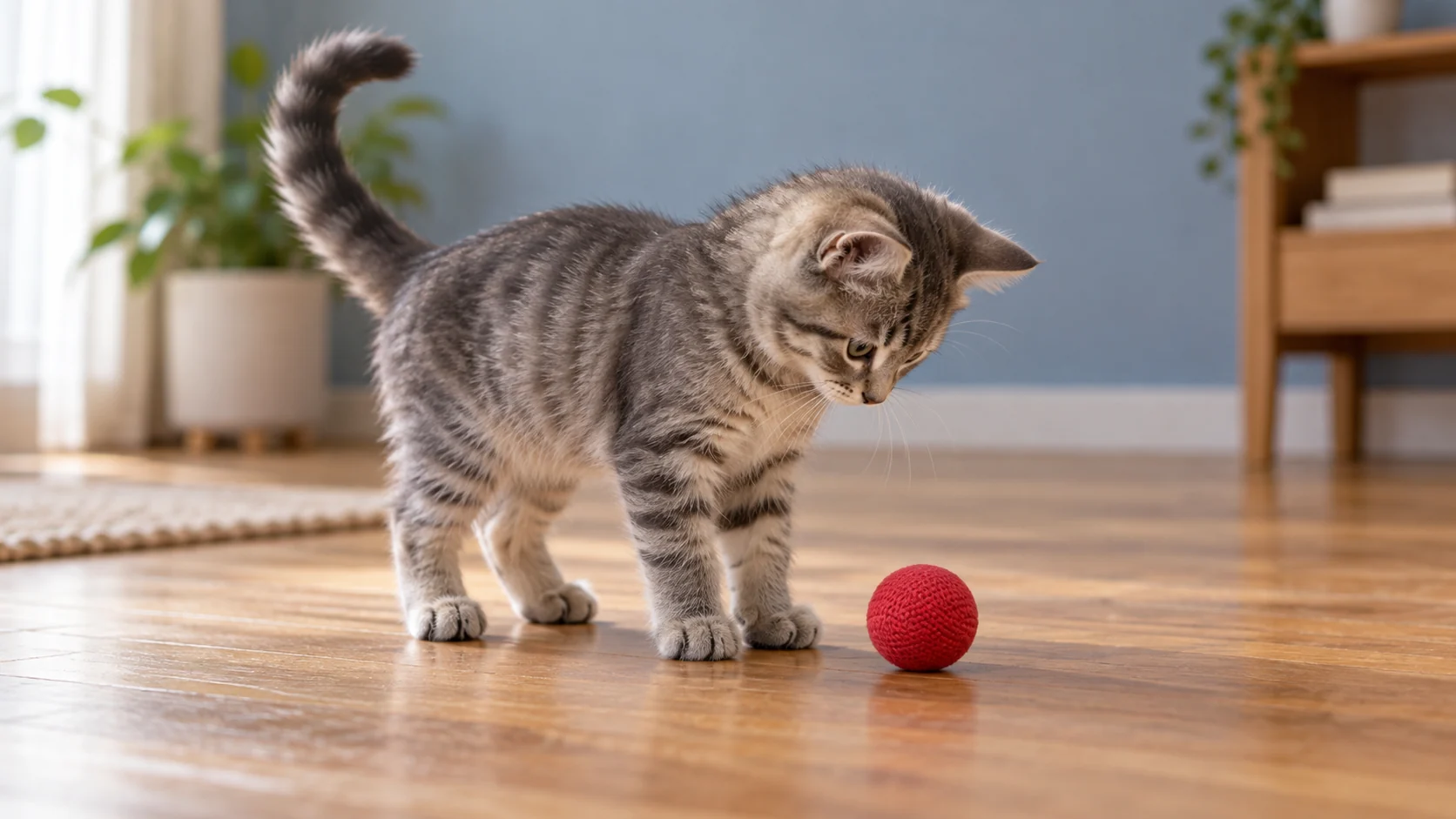
A toy can lie untouched in the middle of a room while a cat spends ten absorbed minutes investigating an empty box. It is a useful reminder: good enrichment is not about how impressive something looks to us. It is about what the cat can do with it.
An indoor routine should offer opportunities to explore, play, scratch, rest, and choose contact. You do not need to introduce all of them at once. Begin with a part of the day that feels limited, then make one useful change.
Build choices before adding excitement
The AAFP and ISFM environmental guidelines emphasize safe places, separated resources, play, comfortable social interaction, and respect for the cat’s sensory world. Their framework treats these as basic needs, not optional luxuries. [1]
Look at the route your cat takes through the home. Can they get to food, water, a resting place, and the litter box without being cornered by another animal? Can they leave an interaction? A new toy will have limited value if access to ordinary resources is uncomfortable.
One simple improvement may be to make an existing favorite place easier to reach. Another may be to offer a second resting option away from a busy room. Let your cat show you which change is useful.
Make play an invitation
Choose a toy that suits your cat’s size, abilities, and way of playing. A lure moved along the floor offers a different experience from a ball that can be batted. Try a short session, pause, and see whether your cat returns to the activity.
Let the cat participate in the sequence rather than waving an object continuously in their face. Movement, pauses, and opportunities to make contact are more informative than a nonstop performance. Do not use your hands or feet as the target.
Inspect toys for parts that could detach. Cornell warns about ingestible small pieces and strand-like components, as well as electrical cords that a cat may chew. Put string or wand toys away securely after supervised play, and remove damaged items. [2]
For a kitten, start with size-appropriate equipment and the manufacturer’s minimum age. For a cat whose movement has changed, do not turn play into a jumping challenge; discuss the change with your veterinarian.
Introduce easy food puzzles
Food puzzles are one option, not a requirement for every meal. A veterinary review by Dantas and colleagues describes introducing them at low difficulty and adapting them to the individual cat. It also makes clear that the evidence includes clinical cases, often with other interventions; those cases cannot prove that a puzzle alone caused the improvement. [3]
Begin with a small portion of familiar food in an easy, suitable device while you watch. Your cat should be able to obtain it. Keep normal food access dependable during introduction, account for the portion in the daily allowance, and stop if the task is frustrating.
An automatic feeder may manage timing, but it does not automatically add a foraging challenge. Conversely, a puzzle can change the task without controlling when or how much food is offered. Decide which problem you are trying to solve before choosing equipment.
Add height and a comfortable way down
Many cats use elevated positions to observe their surroundings. Ohio State recommends stable perches and attention to access and individual preference. [4]
You may already have a useful position that only needs a stable approach and a secure surface. Check the whole route, including descent. A high destination is not helpful if reaching it requires a leap the cat avoids.
A view through a safely secured window can be interesting, but watch your cat’s response. If the sight of another animal repeatedly leads to agitation, that particular view may not be a relaxing attraction. You can adjust access rather than insisting every window must function as entertainment.
Protect quiet time
A hiding place gives a cat a way to withdraw. Ohio State’s refuge guidance emphasizes a secure area with needed resources and freedom from disturbance. [5]
Do not pull your cat out to demonstrate the new toy to a visitor. Explain to children that a cat resting in their retreat gets to stay there. The ability to end an interaction is part of a comfortable routine.
This is also why “more” is not always an improvement. If a new item startles your cat or disrupts a favored resting place, remove it or introduce it more gradually. There is no obligation to make every purchase work.
A practical indoor cat enrichment plan
Choose one activity below that fits your cat’s existing abilities. These are ways to put the guidance above into practice, not tested treatment protocols. If your main question is whether a change in behavior needs attention, start with our cat behavior assessment guide.
Activity 1: A floor-level play invitation
- Equipment and setup: Use an intact wand toy suitable for your cat and a clear patch of floor with secure footing. Check for loose parts before starting. Keep hands and feet out of the game.
- What you do: Move the lure away from the cat, pause, and allow them to approach and make contact. Stay present and let them decide whether to continue.
- Make it accessible: Keep the lure within easy reach rather than requiring a jump. To simplify, slow the movement and shorten the distance.
- When to stop: End the invitation if your cat leaves, appears uncomfortable, or becomes frustrated. Remove a damaged toy immediately and put the wand and string securely away afterward. A new difficulty moving deserves veterinary advice.
Activity 2: An easy food-puzzle introduction
- Equipment and setup: Choose a suitable, intact food puzzle that can be set to its easiest level. Use a small portion of familiar food from the daily allowance, following the device’s instructions.
- What you do: Place it on a stable, accessible surface and watch the first attempt. The food should be easy to find and obtain; this is an introduction, not a challenge to endure.
- Make it accessible: Begin at floor level if that is comfortable for your cat. If the easiest setting is still difficult, offer the portion normally and reconsider the device. Keep normal food access dependable.
- When to stop: Stop if the device slides, breaks, or is difficult or frustrating to use. Do not withhold meals to encourage participation. Reduced appetite calls for veterinary advice rather than a harder or more enticing puzzle.
Activity 3: Make an existing lookout easier to use
- Equipment and setup: Choose an existing stable resting surface your cat already likes. Check its approach, footing, and route back down. Keep any nearby window securely closed or safely secured.
- What you do: Clear an obstructed approach or offer an appropriately stable, lower resting option nearby. Let the cat investigate without placing them on the perch or coaxing them into a difficult jump.
- Make it accessible: Use a lower destination rather than an improvised stack of furniture. The return route matters as much as the climb.
- When to stop: Remove an unstable option. Reconsider the location if the view repeatedly causes agitation. If a once-easy route has become difficult, discuss that change with your veterinarian.
Keep a one-change activity record
Copy these fields into a note. Record what you saw, including a decision not to participate. There is no required play duration, pass mark, or boredom score.
| Field | What to write |
|---|---|
| Invitation | Date, time, place, and the one activity or setup change offered. |
| Choice | Approached voluntarily, watched, returned, or left. |
| Access | Could reach the toy, obtain the food, or use the whole route comfortably. |
| End of activity | What happened when you paused, and whether your cat could leave freely. |
| Next step | Keep the setup, simplify one feature, remove it, or discuss a concerning change with the vet. |
Hypothetical entry, not a tested case: After breakfast, living-room floor; familiar wand toy. Watched the fast lure without approaching. Approached when the lure slowed, touched it, then walked away. Next invitation: start slowly in the same place. This suggests a feature worth trying again; it does not establish why the cat responded.
The goal is not to keep your cat busy at all times. It is to make more of their day available on their terms: a place to watch, something worth investigating, a chance to play, and somewhere peaceful to stop.
Continue exploring
Sources
- Ellis SLH, et al. AAFP and ISFM Feline Environmental Needs Guidelines. Journal of Feline Medicine and Surgery. 2013. doi:10.1177/1098612X13477537. Consensus guideline.
- Cornell Feline Health Center. Safe Toys and Gifts. Veterinary safety guidance; accessed September 12, 2026.
- Dantas LMS, Delgado MM, Johnson I, Buffington CAT. Food Puzzles for Cats: Feeding for Physical and Emotional Wellbeing. Journal of Feline Medicine and Surgery. 2016;18:723–732. doi:10.1177/1098612X16643753. Clinical review with case examples; not a product comparison trial.
- The Ohio State University College of Veterinary Medicine, Indoor Pet Initiative. Perches. Accessed September 12, 2026.
- The Ohio State University College of Veterinary Medicine, Indoor Pet Initiative. Refuge. Accessed September 12, 2026.