
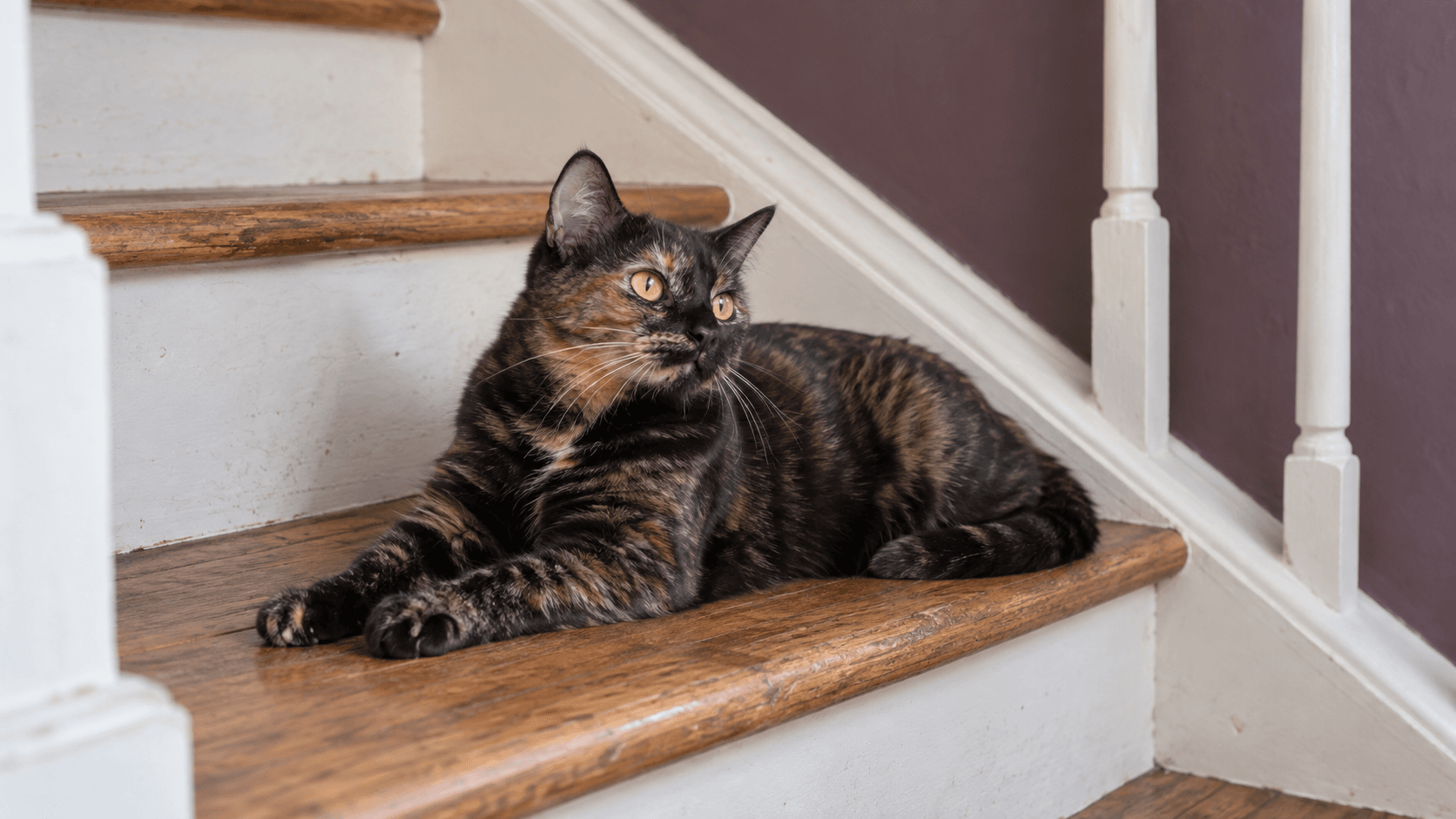
Your cat has a comfortable home, regular meals, and a window with a view. Yet something feels different: less interest in play, more nighttime calling, or repeated attacks on your ankles as you walk past. Is indoor life becoming dull?
It is a reasonable question, but it is only one of the questions worth asking. Changes that look like boredom can also reflect pain, fear, conflict, or illness. Start by noticing the change rather than deciding what your cat must be feeling.
Sleep is not a boredom test
Cats spend substantial time resting, and their active periods do not necessarily match our schedules. Ohio State describes feline sleep and activity as a pattern that can be influenced by the environment and interactions with people. Counting sleeping hours alone cannot establish whether a particular cat is bored. [1]
A more useful comparison is with your own cat’s usual routine. Have they stopped using a favorite perch? Do they still investigate familiar activities? Has their appetite, grooming, movement, or litter box use changed?
The difference between “she always naps here after breakfast” and “she now stays here instead of doing anything else” matters more than whether another cat online sleeps less.
Record the change before naming the cause
Compare your cat with their own usual behavior. A short note can help distinguish an unchanged preference from a new loss of interest or ability. Do not delay veterinary advice to collect several days of observations; the care guidance below applies as soon as concerning signs appear.
| Field | What to record |
|---|---|
| Usual pattern | What your cat normally does in this place or at this time, including comfortable rest. |
| Observed change | What they now do differently. Describe movement or actions rather than writing only “bored” or “lazy.” |
| Onset and pattern | When you first noticed it; whether it occurs at a particular time, location, or interaction; whether it is becoming more frequent. |
| Surroundings | Visitors, noise, schedule changes, another animal nearby, a closed door, or a route that has become difficult. |
| Other changes | Appetite, grooming, jumping or walking, sensitivity to touch, hiding, and litter box use. Write “not observed” when you do not know. |
| Choice and access | What happens when your cat can freely approach or leave an ordinary, familiar activity. Do not force participation to complete the note. |
Environmental context still matters. The AAFP/ISFM environmental guidelines describe safe places, accessible resources, play opportunities, comfortable social contact, and a familiar sensory environment. Use those needs to spot a changed opportunity, such as a pet blocking a doorway. They are not a validated checklist for diagnosing boredom. [2]
Behavior changes that deserve veterinary advice
A cat who eagerly joins a familiar game may benefit from more opportunities for it. That observation does not prove that a behavior problem has a single environmental cause. Likewise, refusing a toy is not enough to label a cat lazy.
If your cat is eating less or stops eating, contact your veterinarian promptly. Appetite loss in cats can have significant consequences and is not a problem to solve by withholding food until a puzzle becomes interesting. Cornell specifically recommends veterinary consultation when signs of anorexia appear. [3]
Changes in toileting also deserve medical consideration. Repeated straining with little or no urine is an emergency, especially in male cats; it can be mistaken for constipation. Seek urgent veterinary care instead of waiting to see whether a different box or more play helps. [4]
Persistent hiding, reduced jumping, a change in grooming, or new sensitivity to touch should also be discussed with your veterinarian. The aim is not to turn every quiet afternoon into a concern. It is to avoid explaining away a meaningful change.
Two observations that lead to different next steps
Hypothetical example: a preference to explore. A cat has always rested after breakfast. They watch a fast-moving toy but voluntarily approach it when the movement slows. Their observed appetite, movement, grooming, and toileting remain usual. Record the response and try the slower invitation again. It is a useful preference observation, not proof of boredom or proof that nothing medical could be wrong.
Hypothetical example: a change to discuss with the vet. A cat who normally uses a favorite perch now stays below it and is eating less. Record when this began and contact the veterinarian promptly. Do not make the cat jump to test them or wait for a new toy to solve the problem. Reduced appetite and a change in usual movement alter the next step.
If there are no concerning changes requiring care, choose one modest adjustment from our step-by-step indoor cat activities. Keep the rest of the routine reasonably consistent and record what your cat chooses. Changing food, litter, resting places, and toys together makes the response harder to interpret.
Keep the question open
There is no need to decide between “my cat is bored” and “my cat is sick” before asking for help. Environmental and medical issues can overlap. Bring your observations, and videos when useful, to a veterinary appointment if the change persists or troubles you.
Your cat does not need an endlessly exciting home. They need a home they can use comfortably, with opportunities that make sense to them and a person who notices when something is no longer quite right.
Continue exploring
Sources
- The Ohio State University College of Veterinary Medicine, Indoor Pet Initiative. Sleeping Habits. Veterinary educational guidance; accessed September 12, 2026.
- Ellis SLH, et al. AAFP and ISFM Feline Environmental Needs Guidelines. Journal of Feline Medicine and Surgery. 2013;15:219–230. doi:10.1177/1098612X13477537. Consensus guideline.
- Cornell Feline Health Center. Anorexia. Veterinary educational resource; accessed September 12, 2026.
- Taylor S, et al. 2025 iCatCare Consensus Guidelines on the Diagnosis and Management of Lower Urinary Tract Diseases in Cats. Journal of Feline Medicine and Surgery. 2025;27. doi:10.1177/1098612X241309176.