
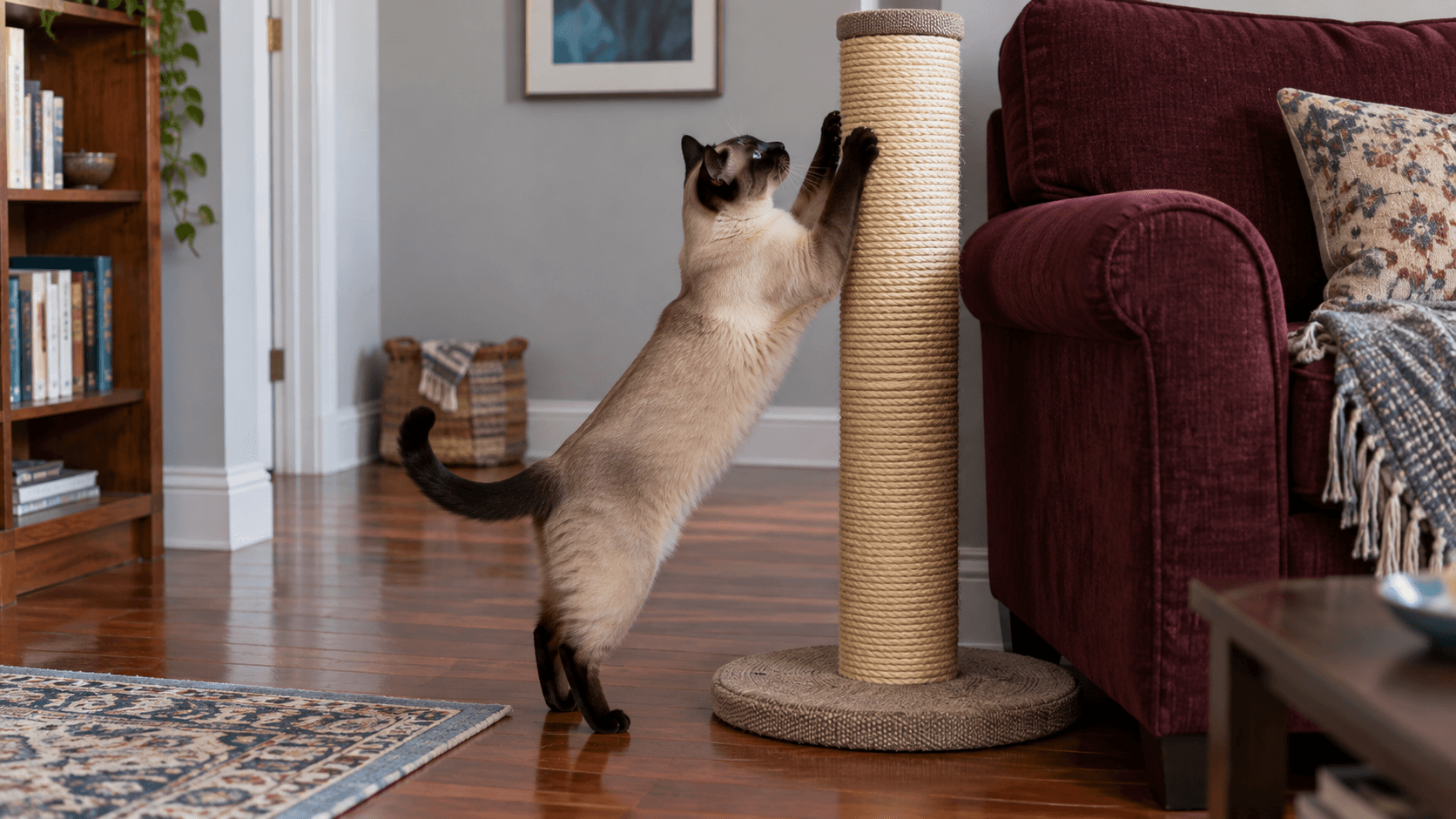
The new scratching post is in the corner. Your cat is using the couch again. Before deciding the post has been rejected out of stubbornness, look at the difference between the two locations: one may be central, stable, and used every day; the other may be out of the way and wobble when touched.
Scratching is normal feline behavior. The realistic goal is to provide an acceptable place that serves the same need, not to make your cat stop scratching altogether.
What scratching does for a cat
Ohio State’s veterinary guidance describes scratching as a way to stretch, maintain the outer claw covering, and leave marks. It recommends considering the surface, orientation, stability, and location a cat already prefers. [1]
That explains why a post can be well made and still be the wrong option. A cat who scratches horizontally may not immediately choose a narrow upright pole. A post too short for a comfortable stretch or one that tips during use may offer a poor substitute for a solid chair leg.
Start with what you can observe: where the cat scratches, which direction their body moves, and what texture their claws engage.
Where to put a scratching post
Place a suitable scratcher close to the site already being used. If your cat scratches near a resting area, consider a stable option there. In a multi-cat home, more than one accessible scratching location may be useful. [1]
This may conflict with the place you would prefer to keep the scratcher. Treat the first position as a functional decision. Once your cat reliably uses it, you can assess whether another nearby arrangement works, but moving it abruptly to a distant room may remove the feature that made it useful.
Keep the furniture protection separate from the invitation to scratch. A securely fitted cover approved for the upholstery may protect the surface while you work on the alternative. Avoid barriers that create sharp edges, entanglement hazards, or unstable objects.
What a large survey adds and what it cannot prove
A 2024 study examined caregiver questionnaire data from 1,211 cats. It found associations between reported unwanted scratching and several household or behavioral factors, including scratching-post placement. The study was cross-sectional and relied on caregiver reports, so it cannot prove that any single factor caused the scratching. [2]
The study population also matters: these were single-cat households in France whose caregivers reported unwanted scratching and already provided a scratching device. The results therefore do not tell us how common unwanted scratching is among all cats, and they should not be transferred directly to multi-cat households. See the study’s eligibility criteria and methods.
The research was funded by Ceva Santé Animale, and several authors were company employees. That context belongs alongside the findings, particularly when discussing behavior products. We are not using the study to claim that a pheromone product is necessary or that one household change will work for every cat.
The practical lesson is to examine the whole setup rather than blaming one person, pet, or event. A survey association is not a reason to conclude that a child caused a cat’s behavior or that all lively play should be stopped.
How to encourage your cat to use a scratcher
Offer the scratcher without placing the cat’s paws on it or restraining them beside it. When your cat chooses to investigate or use it, you can provide a reward they enjoy. Keep the interaction calm enough that the cat can leave.
Try changing one feature at a time. If a vertical post is ignored, consider whether it is stable and tall enough, then whether another material or a horizontal option better matches the observed behavior. This is a practical preference trial; it does not require buying several elaborate structures at once.
Do not shout, chase, or spray water at the cat. The feline environmental guidelines emphasize predictability, choice, and positive interaction. Making a person or a room threatening does not teach which scratching surface is acceptable. [3]
Avoid essential oils, perfumes, or improvised repellents. This guide does not recommend odor-based deterrents or assume that a substance described as natural is appropriate for a cat or your upholstery.
Look beyond the damaged surface
If the scratching changes suddenly, ask what else changed. Is a new animal restricting access to resources? Has a favorite resting spot disappeared? Is the household noisier? These questions help identify adjustments worth discussing; they are not a diagnosis of stress.
Arrange veterinary advice if the behavior accompanies pain, reduced movement, skin changes, a damaged claw, altered appetite, or other new signs. Scratching furniture and scratching an irritated part of the body are different behaviors and should not be confused.
Nail care may reduce the sharpness of claw tips, but it does not remove the need to scratch. Ask your veterinary team to demonstrate appropriate trimming if you are unsure. The AVMA strongly discourages declawing of domestic cats and emphasizes alternatives that allow cats to express normal scratching behavior. Discuss humane options with your veterinarian. [4]
Match the scratcher to the surface your cat uses
Start with one damaged site and make a matching note. This applies the placement and preference guidance above; it is not a validated behavior test.
| Observe | Check the alternative |
|---|---|
| Direction | Upright stretching on a chair or sofa side suggests trying a stable vertical surface. Scratching along a rug suggests checking a horizontal option. |
| Texture | Describe the surface already used and the scratcher’s material. A broad material preference is something to explore, not something you can infer from one scratch. |
| Reach and footing | Is there room for the cat’s usual stretch, and does the base stay put? Check assembly and stability before inviting use; do not hold the cat against it to test the fit. |
| Location | Place the alternative close to the actual scratching site without blocking a doorway or escape route. A hidden corner elsewhere may not serve the same purpose. |
| Timing and choice | Record when scratching happens, which surface is chosen, and whether other animals or obstacles limit access. |
Hypothetical filled record: Sofa arm beside the cat’s usual sleeping place; upright stretch after waking. Existing post is stable but across the room. First adjustment: place that post beside the sofa arm, keeping the route open. Record use of both surfaces before deciding whether to change the material. This describes a trial to make, not a reported success.
Change one suitable feature at a time. Keep a useful location available, reward voluntary investigation or use, and stop using equipment that becomes unstable or damaged. New pain, claw damage, or other health changes need a veterinary discussion rather than a better matching score.
Judge the plan by use, not appearances
Over the next several days, note which surface your cat chooses and when. A scratcher that is becoming visibly worn may be doing its job very well. Keep useful locations available, maintain stability, and replace damaged equipment when necessary.
The best arrangement may not look exactly like the one you imagined. It should, however, make sense from the cat’s side of the room, and give the furniture a better chance.
Continue exploring
Sources
- The Ohio State University College of Veterinary Medicine, Indoor Pet Initiative. Scratching. Used for normal function and scratcher selection/placement. This article does not adopt the source’s odor or abrasive deterrent suggestions. Accessed September 12, 2026.
- Demirbas YS, Pereira JS, De Jaeger X, Meppiel L, Endersby S, da Graça Pereira G. Evaluating Undesired Scratching in Domestic Cats: A Multifactorial Approach to Understand Risk Factors. Frontiers in Veterinary Science. 2024;11:1403068. doi:10.3389/fvets.2024.1403068. Cross-sectional caregiver survey; industry funding and author affiliations disclosed.
- Ellis SLH, et al. AAFP and ISFM Feline Environmental Needs Guidelines. Journal of Feline Medicine and Surgery. 2013. doi:10.1177/1098612X13477537.
- American Veterinary Medical Association. Declawing of Domestic Cats. Official animal-welfare policy; current policy revised in 2025; accessed October 3, 2026.
Reviewed: October 10, 2026