
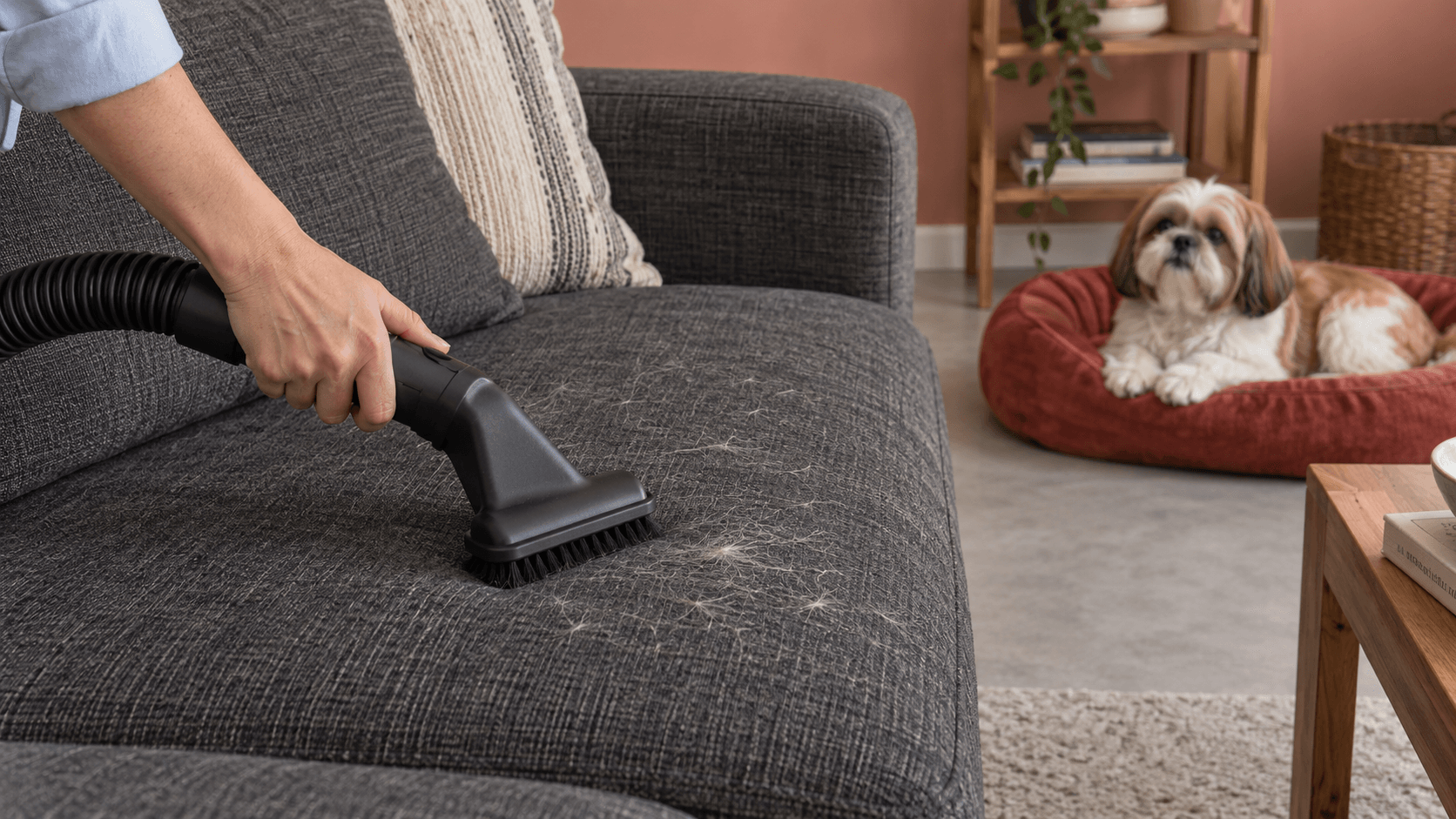
The couch can look clean until sunlight reveals a second upholstery layer made entirely of pet hair. Before reaching for a wet glove, a rough scraper, or a homemade spray, check what the couch itself can tolerate.
The safest starting point is the furniture’s care instructions. Hair removal is usually a mechanical task. Adding water, solvent, or friction without checking the material can turn a removable nuisance into a permanent mark.
Check the couch’s upholstery care code
Look beneath cushions or under the furniture for care information. Keep the manufacturer’s instructions for the exact piece as the authority; codes are a starting point, not permission to try every product in a category. [1]
| Common code | General meaning | What it does not promise |
|---|---|---|
| W | A specified water-based upholstery method may be used | The cushion cover can go in a washing machine |
| S | A suitable solvent-based method is required | Water or a general household spray is acceptable |
| WS or SW | Certain water-based or solvent methods may be allowed | Any liquid, amount, or technique is safe |
| X | Vacuuming or light brushing only | A wet cloth or stain remover is allowed |
If the label is missing or the material is unusual, ask the manufacturer or an upholstery professional. Leather, suede, velvet, and loose or looped weaves should not be treated as interchangeable surfaces.
Vacuum pet hair gently, if the care label allows it
Move your pet to another comfortable place while you work. Pick up loose objects and inspect the upholstery for damaged seams or areas that might snag.
If vacuuming is allowed, use an attachment suitable for upholstery and follow the vacuum manufacturer’s instructions. Begin gently in a less visible area. Work in manageable sections rather than repeatedly pressing hard over one patch. Remove cushions only as the furniture’s instructions allow, then clear accessible seams and gaps without forcing an attachment into the fabric.
This is a cautious workflow, not a laboratory-tested ranking of hair-removal techniques. If the fabric pulls, pills, changes appearance, or catches in the tool, stop. More pressure is not the appropriate next experiment.
Treat a hair-removal tool as another surface test
Reusable brushes, rollers, and other tools vary in material and edge design. Follow both the tool’s intended-surface guidance and the couch’s care instructions. Test where a small change will be least visible before using the tool across a cushion.
Avoid assuming that a rubber edge, adhesive surface, or “pet hair” label makes a tool universally gentle. We have not conducted comparative fabric-damage tests, so this guide does not recommend a universal scraper or roller.
Do not add fabric softener, essential oils, or a homemade cleaning mixture simply to make hair easier to collect. Without approval for the exact upholstery and use, the mixture introduces additional uncertainty about residues, discoloration, and material compatibility.
Keep hair removal separate from stain treatment
If you find urine, vomit, grease, or another stain, pause the hair-removal process and check the appropriate cleaning instructions. A method that lifts dry hair does not necessarily remove a stain safely.
A zipper also does not prove that a cushion cover is washable. It may exist for manufacturing or filling access. Follow the care label before removing, soaking, or machine-washing it.
For a cover that is explicitly washable, use its specified wash and drying method. A removable, approved furniture cover can make future maintenance easier, but the cover’s washing instructions still matter.
Build a repeatable routine for your couch
Once you have checked the furniture’s care instructions, use this simple record to avoid guessing each time you clean. This is a suggested home observation protocol, not a method we have tested across upholstery fabrics.
1. Record what the furniture allows
Write down the care code and the manufacturer’s instructions. Identify the permitted tool or vacuum attachment. If those instructions are missing or unclear, resolve that before trying a new method.
2. Start with a small, less visible area
Inspect the fabric before you begin. Note existing loose threads, wear, or pilling so you do not mistake them for a new change. Use only a method permitted for that upholstery, and stop if the fabric catches, pulls, or changes appearance.
3. Check both the hair and the fabric
After a gentle pass, inspect the area from the same angle and under the same lighting. A before-and-after photo can help you compare what you see, but it does not establish that a method is safe for every fabric.
| What you observe | What to do next |
|---|---|
| Less visible hair and no apparent fabric change | Continue cautiously in small sections, following the care instructions. |
| Hair remains but the fabric looks unchanged | Check the tool’s instructions before repeating. Do not automatically increase pressure or add liquid. |
| New snagging, pilling, pulled threads, or a change in appearance | Stop using that method. Consult the furniture manufacturer or an upholstery professional. |
| A stain, damp patch, or residue | Pause hair removal and follow the separate instructions for that problem. |
4. Leave a useful note for next time
Record the area cleaned, tool or attachment, approximate time spent, remaining hair, and any fabric change. Keep that note with the care instructions so another household member can follow the same routine.
Judge the result by both hair removal and fabric condition. A cleaner-looking patch is not a successful result if the upholstery has been damaged.
A hair-free couch is not necessarily allergen-free
The EPA explains that animal-associated proteins in materials such as skin flakes and saliva can trigger asthma in sensitized people. Removing visible hair is therefore not the same as eliminating allergens. Its guidance also advises vacuuming furniture when the person with asthma is not nearby. [2]
If allergies or asthma are the main concern, treat that as a separate health-management question with an appropriate clinician. Do not judge exposure control only by whether the fabric looks clean.
For ordinary upkeep, aim for a repeatable, gentle routine. A little hair collected regularly is easier to manage than a rushed attempt to restore the whole couch before guests arrive, and much kinder to the upholstery.
Continue exploring
Sources
- Joint Industry Fabric Standards and Guidelines Committee, American Home Furnishings Alliance. Woven & Knit Residential Upholstery Fabric Standards & Guidelines, 2010 Revision, Section 4: Cleanability of Upholstery Fabrics and Colorfastness to Water and Solvents. Industry upholstery guidance; accessed October 3, 2026.
- U.S. Environmental Protection Agency. Asthma Triggers: Gain Control. Government guidance on pet-associated allergens and exposure control; accessed September 12, 2026. Not a comparative test of upholstery-cleaning tools.
Reviewed: October 26, 2026