
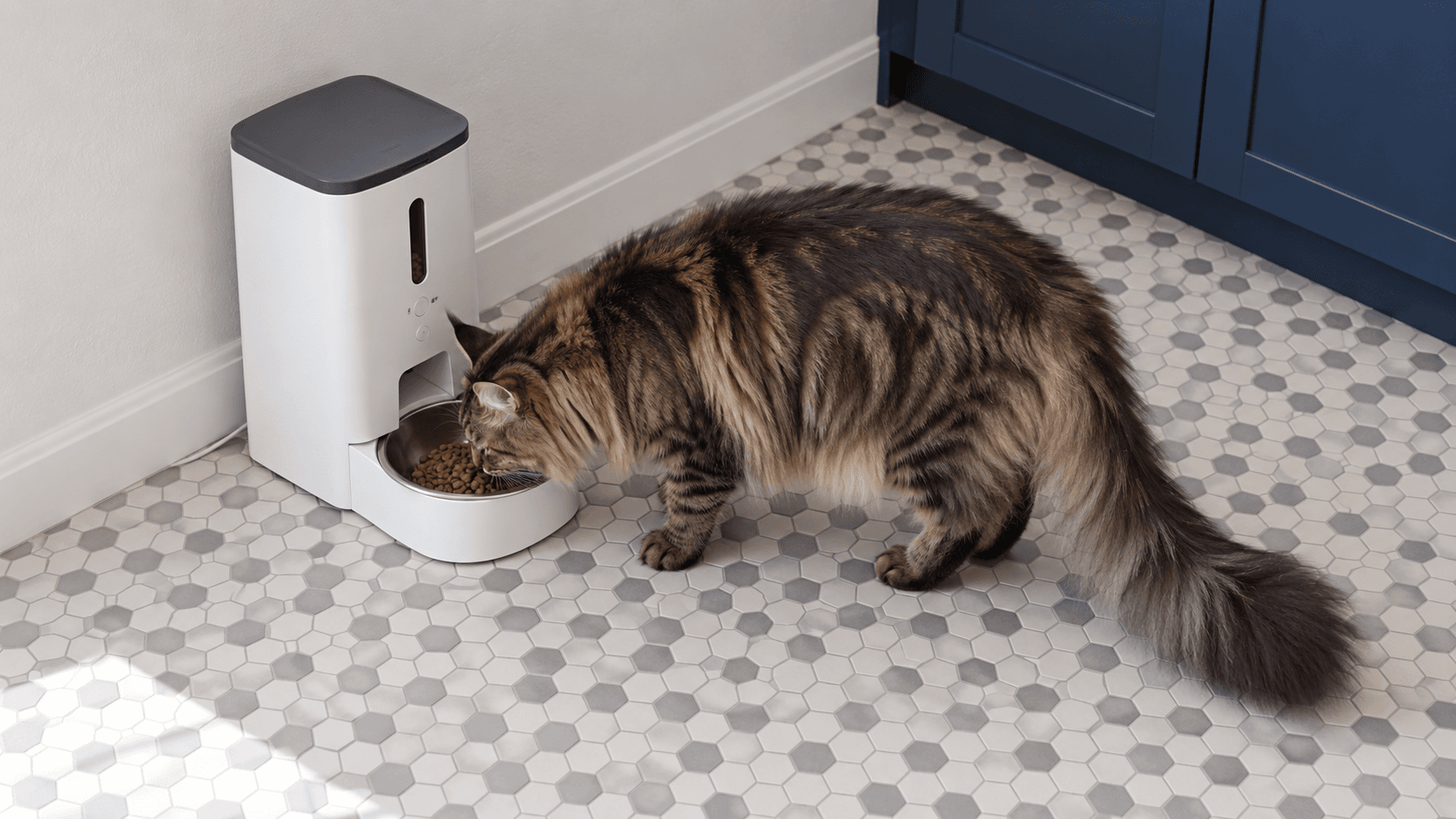
An automatic feeder can make a household run more smoothly. It can release part of a meal before you wake up, divide food across the day, or limit food access to the intended cat. But the reassuring sound of a motor does not tell you whether the right cat ate the right amount.
A feeder can automate part of feeding. It cannot automate care. Choose one for a defined job, then keep the human checks that job still requires.
Compare feeder types by the task you need
Before comparing features, decide which part of feeding you want to automate: dispensing food, presenting a prepared meal, or controlling access to a bowl.
| Feeder type | How it works | What you still need to do | What to check before choosing |
|---|---|---|---|
| Hopper dispenser | Releases food from a storage container into a bowl at programmed times. | Refill and clean the hopper, check actual portions, and confirm that food reaches the bowl. | Compatibility with your food, portion settings, access for cleaning, and instructions for power loss. |
| Compartment feeder | Opens or rotates to expose a portion you prepared beforehand. | Measure and load each meal, remove leftovers, and clean the tray. | Number of compartments, food restrictions, cleaning access, and any cooling requirements. |
| Access-controlled feeder | Opens a covered bowl when it recognizes an authorized pet. | Prepare the meal and observe which pet eats and how much remains. | Identification compatibility, space around the opening, and whether another pet can reach the food during use. |
Three situations that change the choice
You need food dispensed before you wake up. Compare scheduling and portion settings first. A large storage capacity does not tell you whether the smallest serving fits your feeding plan.
You want to prepare individual meals in advance. Compare compartment capacity and food-storage requirements. A timed opening does not, by itself, provide refrigeration.
One cat keeps taking another cat’s food. Compare access controls and the physical feeding space. A timed dispenser alone does not identify the animal eating from its bowl.
Check the parts you will handle every day
Look beyond the outer casing. Identify which surfaces touch food, which parts detach, and whether corners or mechanisms are difficult to reach. Check the cleaning instructions for each component rather than assuming that the entire feeder is dishwasher-safe.
The useful comparison is the work each design automates and the work it leaves to you. More features do not necessarily address your household’s main feeding problem.
Meal timing is only one part of the plan
The AAFP consensus statement on feeding programs recommends dividing a cat’s daily allowance into multiple small meals and considering individual access in multi-cat homes. It notes that automatic feeders can help with timing but do not necessarily provide foraging opportunities. Owners still need to monitor actual intake, weight, and body condition. [1]
That guidance supports thoughtful meal planning. It does not establish that a particular dispenser causes weight loss, prevents disease, or reduces food-related behavior in every cat. The statement is a consensus document, and some contributors disclose pet-food industry consulting relationships.
If your cat has a prescription diet, diabetes, a history of poor appetite, or another condition affecting meals, ask your veterinarian how a feeder could fit safely. Do not let an app determine a medical feeding schedule.
Check the portions yourself
Follow the device instructions and test it with the exact food you intend to use. Weigh several dispensed portions rather than assuming that a setting named “one portion” corresponds to a particular number of calories.
This is a practical verification procedure, not a claim that every feeder is inaccurate. Kibble size and shape, device settings, and the model’s permitted foods can differ. If you change food, repeat the check.
Translate the full daily allowance into the programmed schedule, including treats and any meals you give by hand. Have your veterinary team help establish the allowance when needed. An automated sequence of extra meals is still extra food.
Make a feeder setup record
Keep these notes beside the feeding plan so another caregiver can check the setup without guessing:
- Food and setting: exact food used, permitted kibble size or food type, and the programmed portion setting.
- Portion checks: the weights of several individual dispenses, recorded separately. Repeat this check when the food changes.
- Daily total: food scheduled through the feeder, food served by hand, and treats accounted for in the feeding plan.
- Observed meal: scheduled time, whether food reached the bowl, which cat ate, and whether food remained. An app notification fills in only part of this record.
- Backup: what the manual says about power or network loss, who can respond, and where the usual food and bowl are kept.
Hypothetical arithmetic example, not a feeding recommendation: if a cat’s established daily allowance were 60 grams of one dry food, reserving 10 grams of that same food for hand-feeding would leave 50 grams for the feeder. Programming 60 grams and adding the reserved 10 grams would exceed that allowance. Your cat’s appropriate allowance and any adjustments for treats or other foods need their own feeding plan.
Keep food safety in the decision
The FDA recommends washing food bowls and utensils after use, storing dry food in a cool, dry place, and promptly refrigerating or discarding unused canned or pouched food. It also advises keeping dry food in its original bag. [2]
For a hopper device, load only the amount appropriate for the model and your planned use, and retain the original packaging and lot information for the remaining supply. Empty and clean components as directed rather than continually topping old food with new food.
Do not assume a timed lid makes wet food safe at room temperature for an extended absence. If a feeder advertises cooling, read the tested conditions, food restrictions, and instructions for that exact model. An ice pack or a cooling feature does not establish an unlimited safe holding time.
In a multi-cat home, access matters
A single dispensing point can still be controlled by the most assertive animal. Watch who approaches, who waits, and whether one cat leaves before eating. A feeder should be placed where the intended cat can use it comfortably, with an appropriate plan for other animals. [1]
Access-controlled devices may help in some households, but evaluate the actual approach and exit, tag compatibility, and whether another animal can reach the food. Do not assume that a recognized microchip proves an entire meal was eaten by its owner.
Keep an accessible alternative during introduction. A cat who does not accept a moving lid or unfamiliar sound should not be forced to choose between the device and eating.
Plan for power loss, missed meals, and time away
Check the manual for power loss, battery backup, clock settings, network dependence, and what happens when the food runs low. Test relevant functions while someone is home and can respond. Ask whether the feeder runs its schedule without Wi-Fi and whether a power interruption resets anything important.
App alerts are useful only if someone notices them and can intervene. For travel or an extended absence, arrange a person to check the cat, food, water, and litter box. A camera or dispenser cannot examine an animal or provide treatment.
If your cat stops eating, contact your veterinarian promptly. Cornell emphasizes that appetite loss has many possible causes and can become a serious problem; it should not be dismissed as a feeder preference. [3]
Buy the simplest device that meets the real need
Compare cleaning access, replacement parts, food compatibility, return terms, and any ongoing app charges. This article does not rank models or report hands-on tests, and it avoids prices that could change before you buy.
A good feeder earns its place by doing a specific task reliably in your home. The final check still belongs to you: your cat can reach the meal, eats an appropriate amount, and remains well.
Continue exploring
Sources
- American Association of Feline Practitioners. Feline Feeding Programs: Addressing Behavioural Needs to Improve Feline Health and Wellbeing. Journal of Feline Medicine and Surgery. 2018;20:1049–1055. doi:10.1177/1098612X18791877. Consensus statement; includes disclosed industry consulting relationships. Not a comparative device trial.
- U.S. Food and Drug Administration. Tips for Safe Handling of Pet Food and Treats. Government food-safety guidance; May 23, 2024.
- Cornell Feline Health Center. Anorexia. Veterinary guidance; accessed September 12, 2026.