
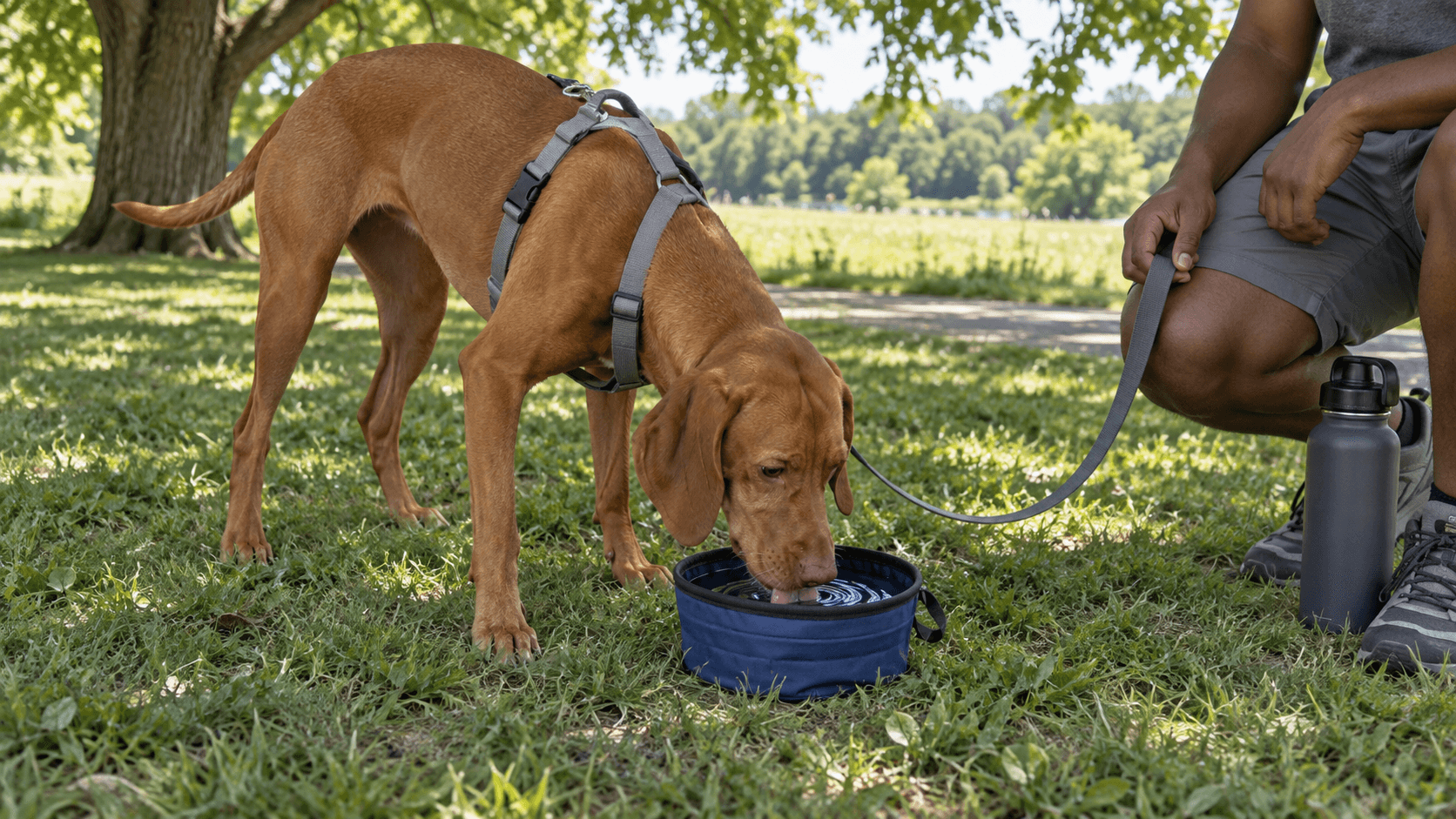
The route is familiar, the leash is ready, and your dog seems eager. On a hot day, none of those things guarantees that the usual walk is a good idea. Heat risk depends on the conditions, the effort involved, and the dog’s ability to lose heat.
If your dog appears to be overheating, stop activity, start cooling with water and airflow, and contact a veterinarian immediately. Heavy persistent panting, breathing difficulty, weakness, confusion, vomiting, seizures, or collapse after heat or exertion can signal an emergency. Do not wait to finish the route or obtain a particular temperature reading. [1]
If your dog is overheating now
Move to shade or a cool area. Apply available cool tap water to the body, getting through the coat to the skin, and use a fan or air conditioning to move air over the wet dog. Keep water away from the airway and do not force water into the mouth. Call the veterinary hospital for directions and transport urgently, continuing safe cooling as advised.
Do not delay while searching for water at a particular temperature. Do not wrap the dog in wet towels as a substitute for active cooling, and do not apply alcohol to the skin. Immersion may be appropriate in some circumstances, but a weak, distressed, or unconscious dog needs protection from drowning and immediate veterinary guidance.
A 2023 study of heat-illness records discusses these prehospital cooling recommendations. Begin cooling while arranging veterinary care; do not wait at home for apparent recovery.
Clinic-call template: “My dog was exposed to [heat or exertion] for about [time, if known]. I am seeing [signs] and have started [cooling already begun]. Please tell me where to bring my dog and how to continue safe cooling during transport.” Give what you know without delaying the call to gather missing details.
Why there is no universal safe temperature
Air temperature is only one part of the situation. Humidity, direct sun, exertion, access to shade, and individual health affect the risk. Cornell identifies short-muzzled dogs, older or overweight dogs, and those with heart or breathing disorders among groups needing particular caution. All dogs can be affected. [2]
A number on a weather app cannot account for all those differences. Neither can a breed list tell you that an otherwise healthy dog is safe to keep exercising. The decision needs to include the animal in front of you and the conditions along the whole route.
If your dog has an underlying condition or a history of heat-related illness, discuss an activity plan with your veterinarian before hot weather arrives.
Plan an outing you can shorten
Choose a cooler time of day, shaded routes, and easy access back to a cool environment. Carry water and offer opportunities to drink. In extreme heat or humidity, keep activity indoors and make outdoor toilet trips brief and appropriate to your dog’s needs. These are consistent with Cornell’s prevention guidance. [2]
For a practical route check, ask three questions before leaving: Where is the first shaded stopping point? How quickly can we return? Who can help if the dog cannot walk back?
Avoid a route that commits you to continuing a long distance before shade or transport becomes available. The goal is to preserve an easy exit, not to prove your dog can still complete a familiar walk.
Hot pavement and paw-pad safety
Pavement can become much hotter than the surrounding air and can injure paw pads. A brief hand test may alert you that a surface is hot, but it cannot certify a safe duration for a dog’s walk. Choose a cooler surface or postpone the outing if there is doubt. [2]
Do not treat boots as permission to exercise in dangerous heat. They may address one aspect of contact with the ground while leaving the dog’s overall heat load unchanged. This article does not evaluate cooling vests, boots, or other products as a substitute for changing the outing.
Signs your dog may be overheating
Compare your dog’s movement and breathing with what is usual for the activity. Slowing down, repeatedly seeking shade, reluctance to continue, unusual drooling, or heavy panting should prompt you to stop and reassess immediately. More serious signs include weakness, disorientation, vomiting, loss of coordination, seizures, or collapse. [1]
Do not encourage a struggling dog to keep going because home is “only a little farther.” Stop the exertion and arrange help. A willing dog may still be accumulating more heat than they can lose.
What cooling studies can and cannot tell us
A 2023 veterinary study of heat-related illness records discusses the recommendation to begin cooling before transport and identifies water application with airflow and appropriate water immersion as recommended approaches. “Cool first” means begin effective cooling promptly while arranging care; it does not mean wait at home until you believe the dog has fully recovered. [3]
In a randomized crossover study, 12 working dogs in training were enrolled and 11 completed the study. Partial water immersion cooled the dogs more effectively than alcohol applied to the paw pads or no active intervention. These were healthy working dogs under a controlled exercise protocol, not collapsed household pets; the study supports the value of water-based cooling without establishing a universal home immersion protocol. [4]
Improvement does not cancel the emergency
Heat-related illness can damage organs, and an animal who looks better after cooling may still need assessment and monitoring. Tell the veterinary team what happened, approximately how long the exposure lasted, what signs you saw, and what cooling you began. [1]
The best hot-weather walk may be shorter than planned, slower than usual, or replaced by a quiet indoor activity. Your dog does not lose anything important when you choose a safer day for the longer adventure.
Suspected heatstroke is a veterinary emergency. This article is general education, not a substitute for emergency instructions for your dog.
Continue exploring
Sources
- Cohen A. Heatstroke: A Medical Emergency. Cornell Richard P. Riney Canine Health Center. Veterinary emergency guidance; accessed September 12, 2026.
- Cohen A. Summer Heat Safety Tips for Dogs. Cornell Richard P. Riney Canine Health Center. Veterinary prevention guidance; accessed September 12, 2026.
- Hall EJ, et al. Cooling Methods Used to Manage Heat-Related Illness in Dogs Presented to Primary Care Veterinary Practices during 2016–2018 in the UK. Veterinary Sciences. 2023;10:465. doi:10.3390/vetsci10070465. Retrospective records study and discussion of prehospital cooling recommendations; not a randomized clinical heatstroke trial.
- Parnes SC, Mallikarjun A, Ramos MT, Stone TA, Otto CM. A Randomized Cross-Over Study Comparing Cooling Methods for Exercise-Induced Hyperthermia in Working Dogs in Training. Animals. 2023;13:3673. doi:10.3390/ani13233673. Twelve working dogs enrolled; limited generalizability to clinical heatstroke.