
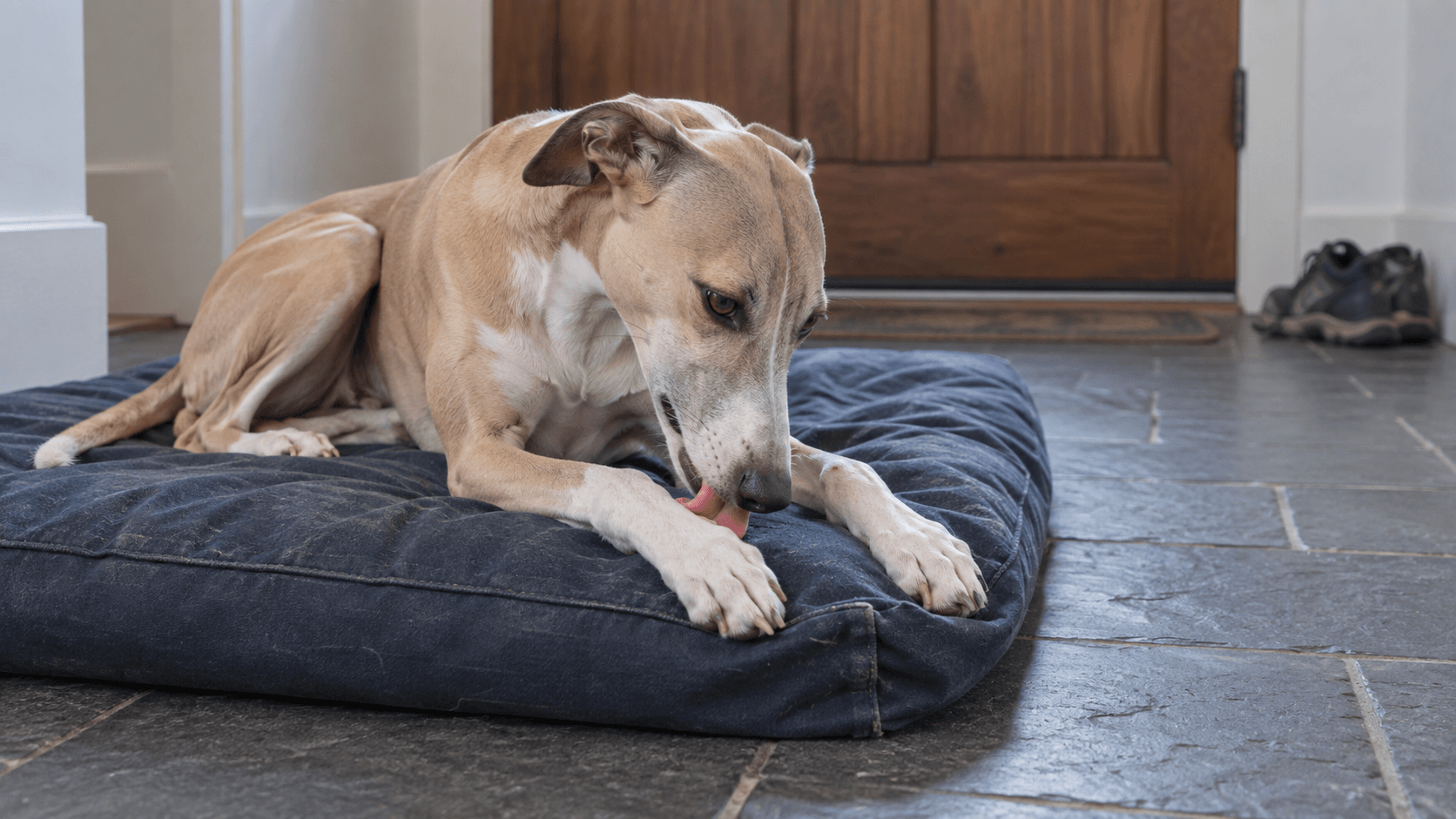
A few licks after a walk are easy to overlook. Repeated licking that interrupts rest, leaves the skin sore, or keeps returning deserves a closer look. The important question is not simply how to stop the licking. It is what is making the paw uncomfortable.
Persistent paw licking is a sign, not a diagnosis. Irritation, an injury, inflammation, infection, parasites, and other problems can produce overlapping behavior. Appearance alone rarely tells the whole story.
When paw licking needs veterinary care
Contact your veterinarian promptly if your dog is limping, the paw is swollen or painful, there is discharge or an open wound, or the licking is persistent or recurrent. Seek urgent care for severe pain, an inability to bear weight after an injury, significant bleeding, a suspected chemical exposure, or a dog who is also unwell.
If your dog resists having the paw touched, do not force the examination. Pain can change how even a normally gentle dog responds. A photograph taken without handling may be more useful than trying to spread sore toes for a better view.
What “pododermatitis” actually means
You may encounter this term in a veterinary discussion. It means inflammation affecting the feet; it does not identify one specific disease. VCA’s clinical overview describes a range of possible underlying causes, including allergies, infections, parasites, foreign material, trauma, and less common systemic disorders. [1]
That distinction matters. Two dogs can have red, licked paws and need different investigations or treatment. Even in the same dog, more than one factor may be involved.
One paw or several: what to tell your veterinarian
The following observations are useful to share with your veterinarian. They are not a way to diagnose the cause yourself.
| What you notice | Why it is useful information |
|---|---|
| A sudden focus on one paw after an outing | The examination may need to look for a local injury, damaged nail, or foreign material |
| Several paws involved, with itching elsewhere | A broader skin problem may need consideration |
| Repeated episodes or apparent seasonality | The timeline can help investigate recurring triggers and underlying disease |
| Redness, swelling, odor, or discharge | The skin needs assessment; appearance cannot reliably identify the organism or cause |
| Licking accompanied by altered movement | Pain or a problem beyond the skin may also need investigation |
The Merck Veterinary Manual describes itching as a clinical sign with multiple causes, commonly involving parasites, infection, and allergy. It also emphasizes that causes can coexist. A secondary infection, for example, may complicate an underlying condition rather than explain why the problem started. [2]
Why “it must be allergies” can lead you astray
Allergy is one possibility, but paw licking alone cannot tell you whether an allergy exists or what the trigger might be. Starting a new food, shampoo, supplement, and topical cream simultaneously can also make a later investigation harder to interpret.
If a food-related problem is suspected, your veterinarian may recommend a controlled diet trial. That is different from casually changing proteins or relying on a marketing label. The trial’s design, duration, and exclusions matter, and unrelated treats or flavored products can interfere with interpretation. [2]
Similarly, brownish saliva staining tells you that an area has been licked. It does not, by itself, identify yeast, prove an allergy, or establish how the problem should be treated.
What a veterinary visit may involve
Expect questions about when the licking began, which paws are affected, outdoor exposures, prior episodes, parasite prevention, diet, and any products already applied. Bring the packaging or a photograph of the label for anything you have used.
The examination may include the skin between the toes, nails, pads, and other areas of the body. Depending on the findings, the veterinarian may examine surface material under a microscope, look for parasites, obtain a culture, or recommend further investigation. Not every dog needs every test. [1]
The point is to connect the visible problem to a cause. If symptoms return after initial improvement, that does not necessarily mean the first treatment “did nothing.” It may mean that a contributing factor still needs attention or that the diagnosis must be reconsidered.
What to do while arranging care
Keep a simple timeline and take clear photographs if your dog allows it comfortably. Note whether licking happens after walks, during rest, or throughout the day, and whether other skin or mobility changes accompany it.
Avoid digging for a suspected embedded object, trimming damaged tissue, or applying a tight home bandage. Ask the veterinary team how to limit further self-trauma safely while you wait. A barrier may be useful in some cases, but it does not replace treatment of the cause.
Do not apply leftover prescription products or start a medicated soak based on an online photograph. Topical products differ, and the dog may lick them off. If medication has already been prescribed for this episode, follow the instructions and ask when a recheck is needed.
Do not give a human pain reliever unless your veterinarian specifically directs you. FDA guidance explains that medicines used by people can be unsafe for pets and that pain treatment needs an appropriate veterinary plan. [3]
Make a paw-licking timeline for the clinic
Use brief entries that separate what happened from what you think caused it:
- When and where: first noticed, which paw or paws, and whether licking follows outings, interrupts rest, or occurs throughout the day.
- What you can observe: limping, swelling, redness, discharge, a wound, or other skin changes, without forcing handling.
- Recent context: outdoor exposures, previous episodes, parasite prevention, diet changes, and any product applied. Keep labels available.
- After veterinary treatment: changes in comfortable walking, skin healing, swelling, discharge, and licking; note the agreed recheck.
Call template: “Since [when], my dog has been licking [paw or paws]. I have also noticed [signs], and have used [products or none]. How soon should my dog be seen, and how can I safely limit further licking while arranging care?” Follow the urgent-care guidance above rather than waiting to collect several entries.
Watch recovery, not just the licking
Ask your veterinarian what improvement should look like and when to call if it does not occur. Less licking is useful, but so are comfortable walking, healing skin, and the absence of recurring swelling or discharge.
Your dog’s repeated attention to a paw is information. Listening to it means looking for the reason, not simply finding a way to make the behavior disappear.
This article provides general education and cannot diagnose or prescribe treatment for an individual dog.
Continue exploring
Sources
- Hunter T, Ward E. Pododermatitis in Dogs. VCA Animal Hospitals/LifeLearn. Veterinary clinical overview; accessed September 12, 2026.
- Moriello KA. Itching (Pruritus) in Dogs. Merck Veterinary Manual. Modified May 2025. Veterinary reference on causes and diagnostic investigation.
- U.S. Food and Drug Administration. Get the Facts about Pain Relievers for Pets. Government medication-safety guidance; accessed September 12, 2026.