
Imagine your flight is delayed, your phone is nearly dead, and the sitter has finished the last visit on the calendar. Your pets still need care. Who knows the trip has changed, and who is responsible for the next visit?
For a trip lasting several days, useful pet sitter instructions need to answer that question as clearly as they explain dinner. Build a plan that names the person responsible, records what actually happened, and makes the next step clear when something changes. A paper folder and a shared document can do the job; the important part is that everyone uses the same current instructions.
Put responsibility on the calendar
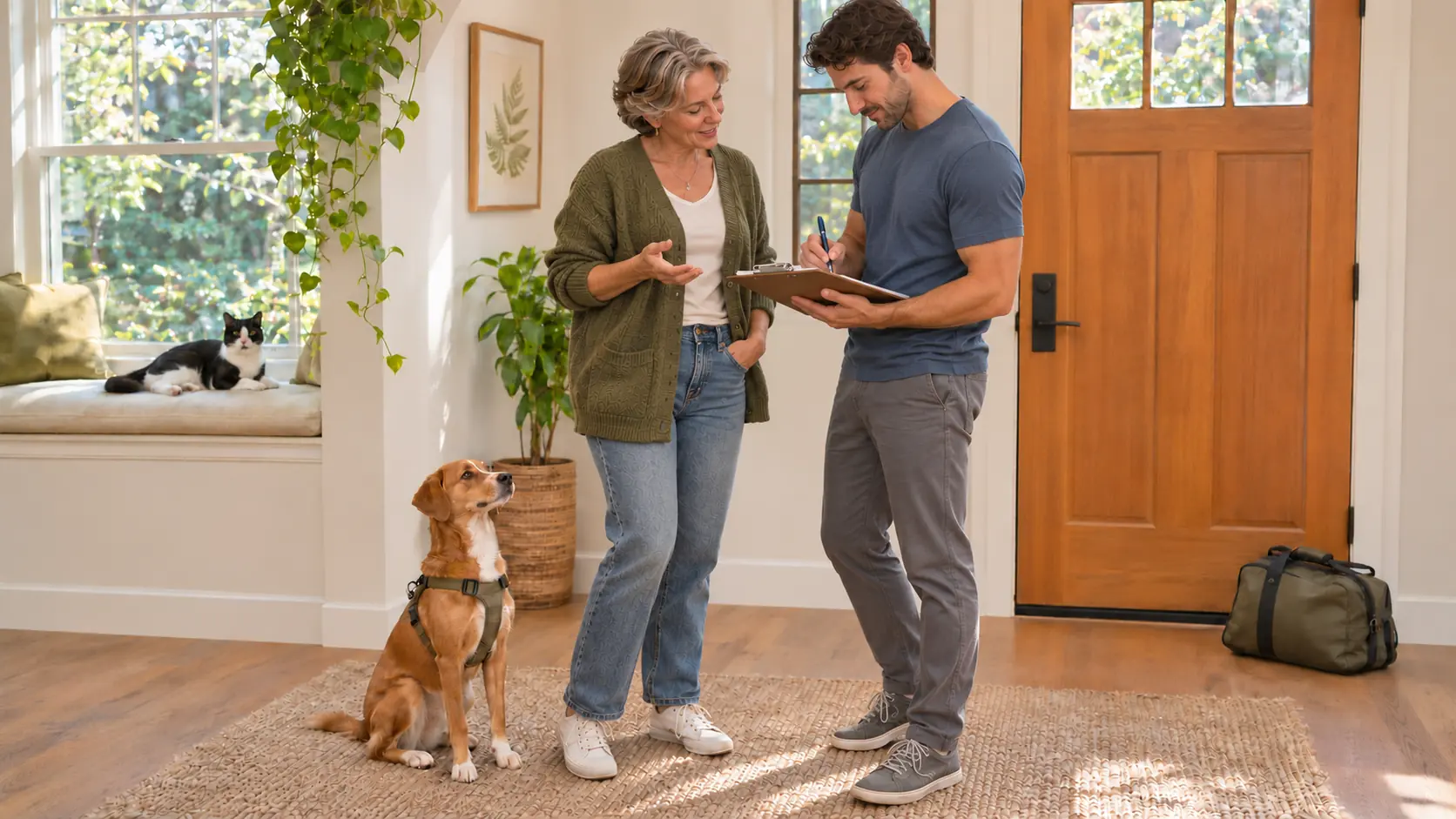
Start with the period between your last care task before leaving and your first one after returning. Include the departure and return days, when it is easy for each person to assume the other has things covered. Write down who owns each visit or overnight stay, the agreed arrival window, and how completion will be confirmed.
Choose coverage around the individual animal’s needs and established routine, with veterinary guidance for medical needs. There is no single visit schedule here that can stand in for that assessment. If the arrangement cannot provide the care your pet needs, change the arrangement before leaving.
Assign two backup roles explicitly. One person may be authorized to make decisions when you are unavailable; another may be the reserve caregiver who can physically get to the house. The same person can fill both roles, but only if they have agreed and can do both jobs.
For a missed or unconfirmed visit, write an escalation rule with names: who checks on the sitter, when the reserve caregiver is contacted, and who confirms that the replacement visit is covered. Set the timing around your pet’s care requirements. A silent group chat is not confirmation that someone has taken over.
Give each animal a page of their own
AAHA recommends individual pet information, current photos, routine details, and the locations of care supplies. For a household with several animals, make it clear which instructions belong to which pet.[1] Put the pet’s name on every page instead of relying on “the older one” or “the small bowl.”
Use the guide below to organize the details, then fill in a separate care sheet for each pet and attach the current veterinary instructions where needed. Keep access credentials in a separate, private handoff. The care sheet can point to that arrangement without putting door codes in a widely shared document.
What belongs on each pet’s care sheet
| Part of the plan | Details to prepare |
|---|---|
| Identity | Name, recent photo, age, distinguishing features, and relevant health or handling needs. |
| Food, water, and routine | Food amount, times, location, and separation needs; where to check and refresh water; the agreed toilet, litter, activity, and rest routine. |
| Medication | Where the current veterinary instructions and labeled medicine are kept; who is responsible for each scheduled administration. |
| Finding and observing | Usual resting or hiding places, typical behavior, and individual changes the veterinary team has said to report. |
| Supplies and contacts | Locations of care equipment; regular and emergency veterinary contacts; owner and alternate contacts. |
| Version | Trip dates, date and time last revised, and the person who confirmed the sitter received this version. |
Try to write instructions someone can act on without translating your habits. “Use the usual scoop” leaves a question if two scoops are in the cupboard. Identify the correct measuring tool and the amount it should contain. Separate household chores from pet care so collecting the mail does not obscure an unfinished care task.
Record the visit that happened
A scheduled visit and a completed visit are different things. Agree on a short record that names the caregiver, the actual arrival and departure times, and each pet checked. Record observations separately from tasks: “food offered” does not say whether a particular animal ate it.
For example, in a hypothetical two-cat household, a message saying “bowls empty” does not establish which cat ate. A more useful update says which cat was observed eating, what remained, and whether either cat could not be checked. An observation that is missing should stay marked as missing, with the agreed follow-up recorded. If a feeder handles part of the routine, specify the human checks too; our automatic cat feeder guide explains the equipment’s limits.
What to record after a visit
| Record | What to write |
|---|---|
| Visit | Date; caregiver; actual arrival and departure; pets checked. |
| Care completed | Tasks actually done, with the relevant pet named. Record medication administration separately and immediately. |
| Observations | What was seen: eating, drinking, toileting, movement, or behavior. Identify anything that could not be checked. |
| Unfinished work | What remains, who was contacted, the advice received if applicable, and who accepted the next action. |
The downloadable form includes a blank visit record. Copy that page for each visit so the next caregiver can see the latest completed entry.
If caregivers change midway through the trip, have the incoming person acknowledge the latest record and any open issue. “I sent the message” is only half of a handoff. This matters even when both people know your pets well.
Settle medication questions before departure
Keep the current veterinary directions accessible and labeled medicine securely stored where the sitter can access it. Confirm the amount, timing, route, storage, and any food instructions with the veterinary team. Ask what the sitter should do if a dose is missed, refused, spat out, or vomited. The answer depends on the medicine; repeating a dose can sometimes give too much. Do not improvise a replacement dose. If too much may have been given, contact the veterinarian immediately.[2]
Review the administration instructions with the sitter in person before leaving.[3] Make sure the chosen caregiver can carry them out. On the visit record, distinguish “given” from “attempted” or “uncertain,” and record the time. An unclear record calls for clarification and veterinary advice, not a guess by the next caregiver.
Make the urgent call route easy to find
Put your regular clinic and an appropriate emergency hospital near the front of the plan. Tell the veterinary team when you will be unavailable and who is authorized to make decisions for your pet. The ASPCA also recommends an alternate contact and a clearly communicated emergency plan.[3] Confirm the clinic’s own authorization and payment arrangements before the trip; do not assume your care sheet completes them.
Difficulty breathing, unresponsiveness, major trauma, or sudden extreme weakness or paralysis warrant urgent veterinary attention. These are examples, not a complete checklist. If the sitter is concerned or unsure, they should contact the veterinary team.[4] For an urgent problem, contact the emergency veterinary team immediately and follow its instructions. Notify the owner and alternate contact without making their reply a condition for seeking care.
Check that the sitter knows where the carrier or leash is and how transport would work. The CDC’s emergency preparedness guidance recommends accessible transport equipment, records, and a local buddy when an owner is away.[5] Applying those basics to a sitter’s stay gives the emergency contacts a practical route to action.
Rehearse the handoff with the plan in hand
Before departure, let the sitter work through the written plan while you are present. This is a chance to find missing instructions. Ask them to locate the supplies, explain which pet receives which care, show how they would record a completed task, and identify the person to call if they cannot make a visit.
Then walk through one ordinary complication: your return is delayed. Who arranges the next visit, where is the updated schedule recorded, and how does the caregiver confirm acceptance? There is no need to stage a stressful situation for the animals. A conversation can expose an assumption that needs fixing.
Test the agreed house-entry arrangement as well. If access depends on a device or a connection, establish a workable backup and give access details only to the people who need them. Keep an accessible copy of the care plan at the house so the sitter can read it without relying on a phone signal.
This plan-and-rehearsal format is a practical organizational approach, not a clinically validated pet-sitting protocol. Adjust it to your household and the care instructions your veterinary team provides.
Keep care assigned until you are home
Give updates a predictable home: one agreed thread or document, with urgent calls handled separately. If an instruction changes, update the master copy and have every affected caregiver confirm the change. Avoid leaving a correction buried in a separate conversation.
Finally, close the trip with an explicit return handoff. Confirm that you are home and taking over, read the last visit record, and resolve any unfinished task. Keep the useful parts of the plan for next time, but recheck the details before another trip. Your pets’ care should not depend on everyone remembering what was true last time.
A CURIOUS LOOK AT LIFE WITH PETS
Continue
Exploring.
Keep following your curiosity.
There’s more to discover.
How to Keep Your Dog Comfortable and Occupied While You’re at Work
Plan everyday coverage around your dog’s needs.
Explore the article
Automatic Cat Feeders: Benefits, Limitations, and What to Check Before Buying
Compare feeding functions, daily upkeep, and backup needs.
IDENTIFICATION & SAFETYPet GPS Trackers vs. Microchips: What Each Can and Can’t Do
Understand how tracking and permanent identification work together.
Sources
- AAHA — Preparing for the Unexpected: Essential Pet Sitter Instructions. April 24, 2025.
- FDA — Medications for Your Pet … Questions for Your Vet.
- ASPCA — Pet Sitter Safety: What to Know Before You Go. December 5, 2017.
- AAHA — Help! Is This a Pet Emergency?. September 5, 2024.
- CDC — Be Prepared: Pet Safety in Emergencies. April 9, 2024.