
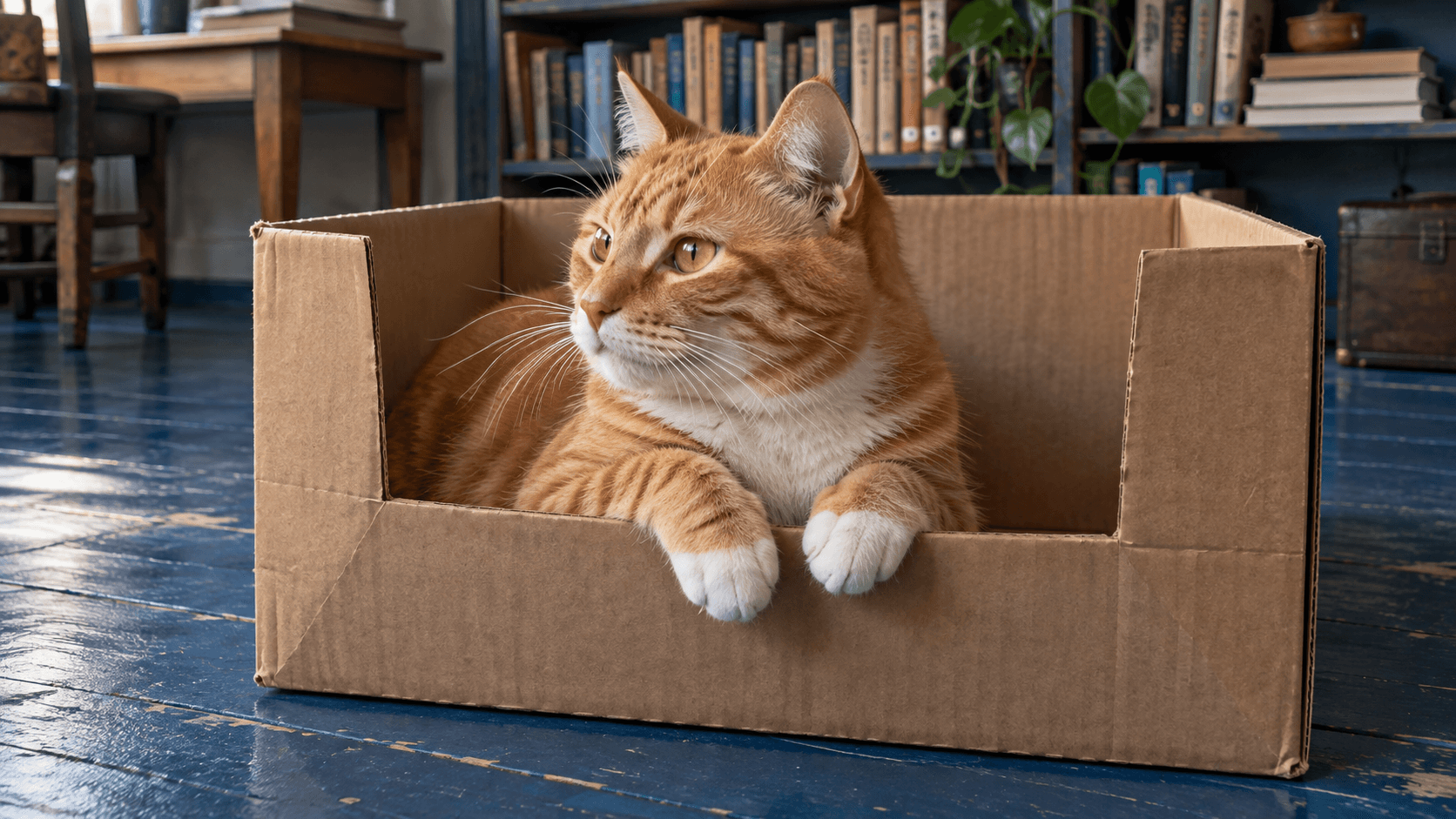
A cardboard box can give a cat a place to withdraw, observe from partial cover, or investigate something new. That combination helps explain its appeal, although individual cats differ. Research supports the value of hiding opportunities in some settings; it does not identify one reason every cat chooses a box.
Hiding is a normal feline behavior. A box can provide an enclosed space, although not every cat prefers the same shape, location, or level of cover. The strongest research-based explanation is more modest than “all cats are irresistibly attracted to cardboard.”
A place to reduce exposure
Ohio State’s veterinary guidance describes hiding as a way cats respond to threatening or unfamiliar situations. Giving a cat a suitable retreat allows withdrawal rather than forcing an interaction. [1]
A box can make part of a room feel less exposed. Depending on the opening, a cat may be able to observe activity while remaining partly concealed. It can also be something new to inspect. These are plausible functions of the design, not proof that we know what a particular cat is thinking.
The important choice is whether the cat can enter and leave freely. A hiding place stops serving that purpose if someone repeatedly reaches inside to pull the cat out.
What the shelter study found
In a 2019 randomized study, researchers assigned 23 newly admitted shelter cats to housing with or without a hiding box during a 12-day quarantine period. Cats given boxes showed a faster reduction in behavioral Cat-Stress-Scores. The investigators did not find a significant protective effect on weight loss, nor a significant difference in adoption rate or length of stay. [2]
That is useful evidence for providing hiding opportunities in the setting studied. It is not evidence that a box cures stress-related illness or that every household cat needs the same box. The sample was small and came from one shelter, where admission and confinement differ substantially from life in a familiar home.
The weight finding matters, too. A behavioral measure improving does not mean every aspect of welfare or health has improved. The authors themselves considered hiding provision only part of the support newly admitted cats may need.
Why your cat’s choice still matters
What draws your cat to a particular box may be the cover, the view through its opening, the location, or the chance to investigate something new. The shelter trial did not separate those possibilities or test whether warmth explained the appeal. It cannot tell you which feature matters in your living room.
Notice how your cat uses the option: do they rest inside, watch from the opening, make a quick inspection, or choose another spot? Let that observation guide whether you keep the box where it is or try another suitable retreat. It is a way to learn about your cat’s preferences, not a home stress test.
How to offer a cardboard box with safety in mind
Start with a place where your cat can withdraw without being disturbed, then use the setup checklist below. These are practical precautions for a household object, not a safety certification; a cardboard box will not suit every cat.
Ohio State’s refuge guidance supports providing a secure area where a cat can rest without disturbance. In a multi-cat home, think about whether one animal can block another’s exit or access. [3]
A safe-box setup to copy
Hypothetical setup: A clean, dry cardboard box on a stable floor in a quiet part of a room the cat already uses. Its opening faces a clear approach, with room for the cat to enter, turn, rest, and leave. No one reaches inside to initiate contact.
- The box: Remove staples, loose tape, exposed adhesive, handles, and packaging. Check for new damage whenever you inspect it.
- The position: Keep food, water, litter access, and walkways clear. Avoid a location where another animal can trap the cat at the opening.
- The introduction: Put it down quietly and let the cat decide. Do not place the cat inside or block the exit to encourage use.
- The decision afterward: If it is ignored, try one different quiet location or another retreat. If it becomes wet, unstable, or damaged, remove it. If the cat tears off and swallows pieces, remove the box and contact your veterinarian about the ingestion concern.
Using the box, ignoring it, or choosing another resting place is information about that option. Sudden persistent hiding or appetite loss needs the different response described below.
When hiding needs a different response
A cat occasionally using a chosen retreat is different from one who suddenly remains hidden, stops eating, avoids movement, or changes their litter box habits. Do not assume that a new box has solved the reason for that change.
In particular, contact your veterinarian promptly if your cat stops eating. Cornell describes appetite loss as a sign with many possible causes and recommends early veterinary attention. [4]
A box can be a small, useful part of a cat-friendly home. Its appeal does not need to be a mystery with one grand answer. Sometimes, it is enough to offer a comfortable choice, and respect the choice when your cat makes it.
Continue exploring
Sources
- The Ohio State University College of Veterinary Medicine, Indoor Pet Initiative. Hiding Instinct. Veterinary educational guidance; accessed September 12, 2026.
- van der Leij WJR, Selman LDAM, Vernooij JCM, Vinke CM. The Effect of a Hiding Box on Stress Levels and Body Weight in Dutch Shelter Cats: A Randomized Controlled Trial. PLOS ONE. 2019;14:e0223492. doi:10.1371/journal.pone.0223492; accessed October 3, 2026.
- The Ohio State University College of Veterinary Medicine, Indoor Pet Initiative. Refuge. Accessed September 12, 2026.
- Cornell Feline Health Center. Anorexia. Veterinary educational guidance; accessed September 12, 2026.