
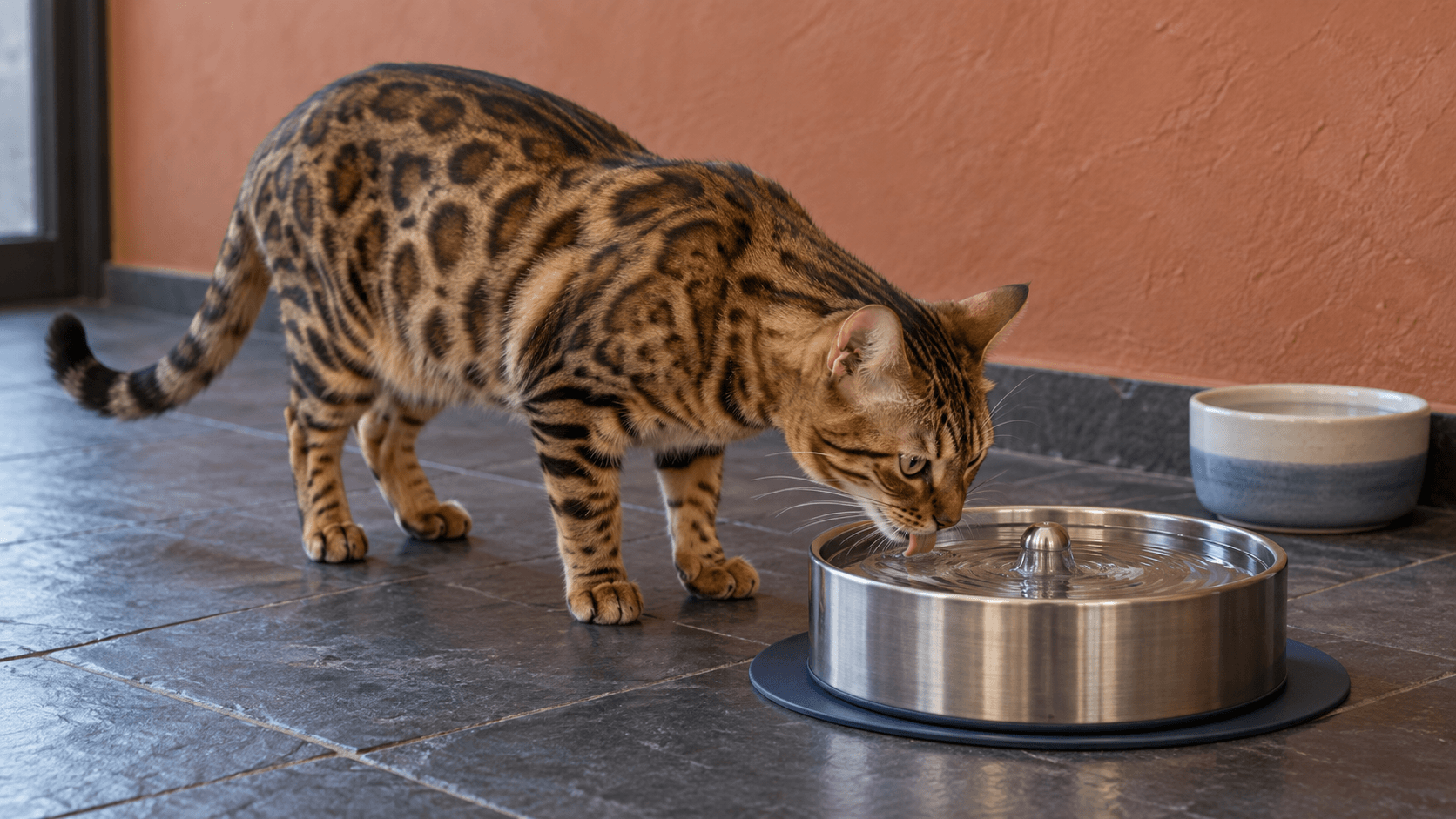
A cat watches a thin stream of water, touches it with a paw, and leans in for a drink. It is easy to see why fountains appeal to owners. The movement is engaging, and the promise often sounds reassuring: more drinking, better hydration, fewer urinary problems.
The research supports a more careful answer. Some cats may prefer a fountain, but studies have not shown that a fountain reliably increases water intake across cats or prevents kidney or urinary disease. Preference, measured drinking, and health outcomes are separate questions.
Three questions to keep apart
First, does the cat approach or use the fountain? Second, does the cat actually consume more total water? Third, does that change produce a meaningful health benefit?
A video can answer part of the first question. It cannot, on its own, answer the other two. Water disappearing from a reservoir may include splashing and evaporation, and a cat can drink less from a bowl while obtaining more water from a moisture-rich diet.
That distinction is important when reading both product claims and research.
The household study: a result sensitive to one cat’s diet
Grant’s 2010 study enrolled 13 healthy cats living in single-pet homes to compare a bowl with a fountain. One cat was withdrawn after adverse behavioral and physical responses to the fountain. Among the remaining cats, the initial analysis found greater water intake with the fountain but no significant difference in urine osmolality, a measure related to concentration. [1]
One owner had added canned food during the bowl period. When that cat was excluded from analysis, the difference in water intake was no longer statistically significant. The study was small, and accurately accounting for splashing and other water loss was difficult.
This is not proof that fountains never help. It shows why an appealing headline such as “cats drank more” needs the details that determine how confidently the result can be interpreted.
The controlled comparison: no overall drinking advantage
Robbins and colleagues compared still, free-falling, and circulating water systems in healthy laboratory cats. Fourteen of 16 enrolled cats completed the randomized crossover study. Overall water intake, urine volume, urine specific gravity, and the measured struvite and calcium oxalate supersaturation outcomes did not differ significantly among systems. [2]
Three individual cats showed a preference in the amount consumed from particular systems, and those preferences were not all for moving water. One urinary measure differed, but its clinical meaning was uncertain.
The controlled setting helped with measurement, yet it also limits generalization: individually housed laboratory cats eating a dry diet are not every household cat. The study does not establish what a particular cat with kidney disease will do at home.
What the more recent review adds
A scoping review published online in December 2025 and in the 2026 volume of the Journal of Animal Science examined 32 publications on feline water intake and related outcomes. Its discussion of water-source studies likewise did not establish a consistent fountain benefit across cats. The review covers broader factors, including diet composition and moisture, rather than functioning as a large clinical trial of fountains. [3]
The review was funded by Peturio Holdings, doing business as CatYears, and author disclosures included industry relationships. These do not erase the findings, but they are relevant context. The primary studies remain important for understanding exactly what was measured.
Why drinking more is not the whole hydration story
Water intake includes water in food as well as water consumed directly. Bowl measurements also become difficult when several animals share a source. A smaller change in the reservoir is not automatically a sign of worse hydration, and a larger change is not automatically an improvement.
For a cat with a medical condition, the meaningful target may involve the diet, urine findings, other clinical measures, and the overall treatment plan. The 2025 iCatCare urinary guidelines describe several different diseases that can produce similar lower urinary signs. A fountain cannot tell you which disease is present or replace its management. [4]
Do not add salt, flavoring, supplements, or a major diet change solely to encourage drinking without veterinary advice, especially when a cat has an existing condition.
What to check before buying a cat water fountain
Treat it as an additional option, not a test your cat has to pass. Keep a familiar bowl available. Place the fountain where your cat can approach and leave comfortably, and observe their response to the sound and movement.
A plain bowl has a simple maintenance routine: empty it, wash it, and refill it with fresh water. A fountain adds a pump, channels, and sometimes a filter to that routine. Before choosing one, read its cleaning instructions and check whether you can reach every part that needs washing. Check replacement-filter availability, safe cord placement, and whether drinking water remains accessible when the power is off. Keep a separate bowl available rather than relying on that feature. These are maintenance and access checks, not evidence that a fountain improves health.
Follow the exact cleaning instructions and inspect all accessible water-contact surfaces. A filter does not remove the need to clean the device or provide fresh water. If maintenance is difficult enough that you are unlikely to do it consistently, a simpler bowl may be the more dependable choice.
We have not tested fountain models in this article and are not ranking them. Noise, cleaning effort, and a cat’s acceptance should be evaluated for the specific device and household.
Keep an observation log for a new fountain
A useful home log answers whether the fountain suits your cat and your routine. Keep the familiar bowl available and record observations without turning them into a medical score.
- Date and setup: fountain location, bowl locations, and which animals can use each source.
- What you saw: drinking, approaching and leaving, pawing at the water, or avoiding the sound or movement. Note which cat you actually observed.
- Water and other changes: refills, visible splashes or spills, and any change in food. Do not label all missing reservoir water as water the cat drank.
- Maintenance: parts cleaned according to the instructions, difficulties reaching surfaces, and any pump or power problem.
- Decision: can your cat use it comfortably, and can you keep it clean and supplied? If either remains a problem, keep a dependable alternative available.
Hypothetical example: the reservoir level falls, but the floor beside it is wet and two cats share the fountain. The useful note is “water loss with visible splashing; individual intake unknown.” It is not evidence that either cat is better hydrated or that urinary disease has been prevented.
When to call your veterinarian instead of changing equipment
Contact your veterinarian for a clear change in thirst or urination, reduced eating, vomiting, or other signs of illness. Repeated attempts to urinate with little or no output are an emergency, particularly in male cats. Do not wait for a new water source to help. [4]
A fountain can be a perfectly reasonable preference purchase. Keep a fountain because your cat uses it comfortably and you can maintain it well, rather than because of an unproven health promise.
Continue exploring
Sources
- Grant DC. Effect of Water Source on Intake and Urine Concentration in Healthy Cats. Journal of Feline Medicine and Surgery. 2010;12:431–434. doi:10.1016/j.jfms.2009.10.008. Small household comparison with a diet-related confounder.
- Robbins MT, et al. Quantified Water Intake in Laboratory Cats from Still, Free-Falling and Circulating Water Bowls, and Its Effects on Selected Urinary Parameters. Journal of Feline Medicine and Surgery. 2019;21:682–690. doi:10.1177/1098612X18803753. Randomized crossover study; 14 cats completed.
- Kosmal PAL, Shoveller AK, Gillies G, Armstrong LE. Diet Format, Protein, Amino Acids, Salt, and Osmolytes, as Well as Water Viscosity, Affect Water Consumption in Domestic Cats: A Scoping Review of 32 Publications. Journal of Animal Science. 2026;104:skaf434; online December 13, 2025. Scoping review; funding and conflicts disclosed in the paper.
- Taylor S, et al. 2025 iCatCare Consensus Guidelines on the Diagnosis and Management of Lower Urinary Tract Diseases in Cats. Journal of Feline Medicine and Surgery. 2025. doi:10.1177/1098612X241309176.