
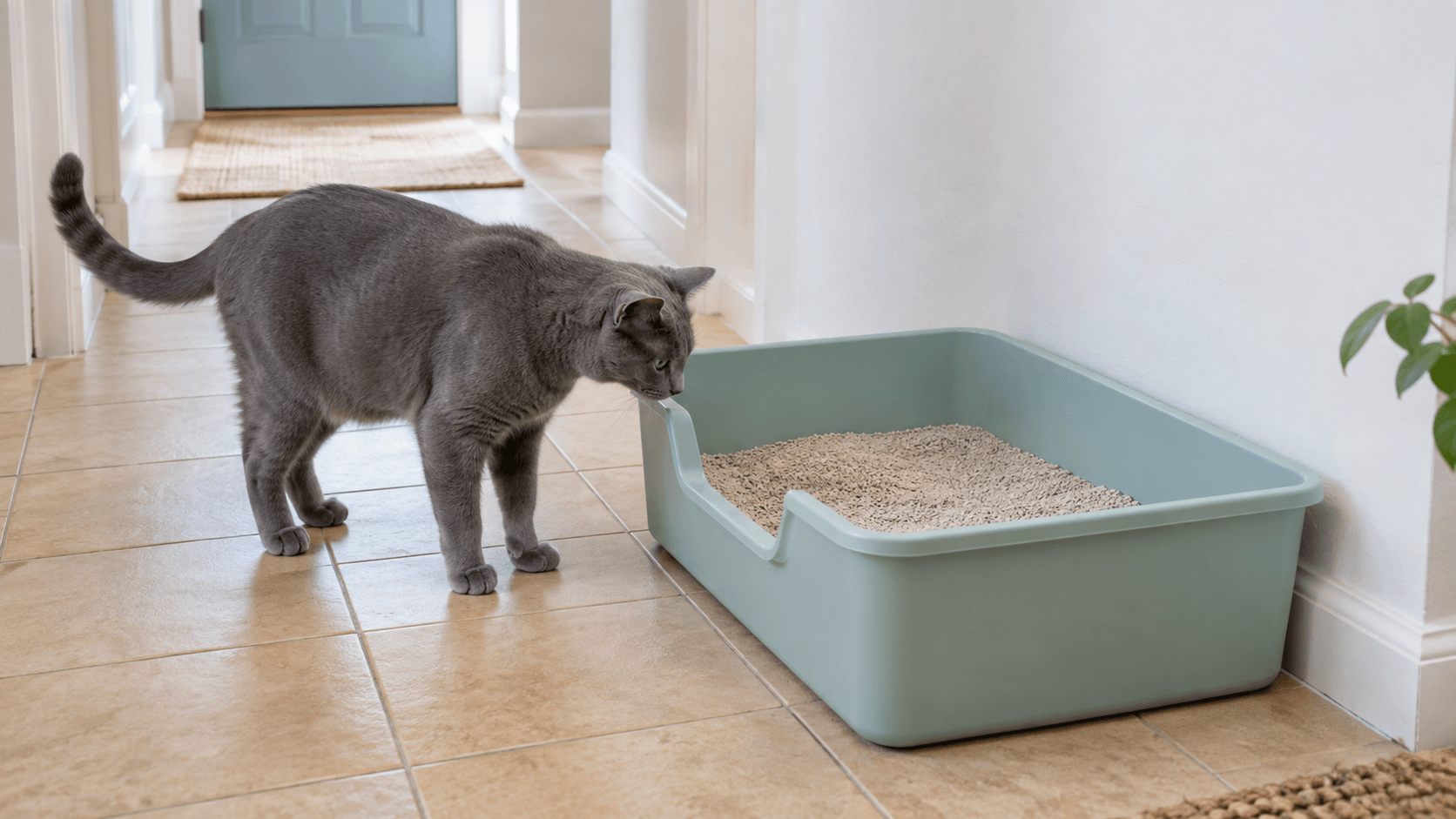
From a person’s perspective, a litter box tucked behind the washing machine may be convenient. From a cat’s perspective, it may mean a noisy trip into a narrow space with only one way out. The location can be tidy and still be difficult to use.
A good setup gives each cat comfortable access to a clean, suitable place to eliminate. Box count matters, but it is only part of the arrangement.
First, a medical distinction: repeated straining with little or no urine can indicate a life-threatening urinary obstruction, particularly in a male cat. Seek emergency veterinary care immediately; do not wait to try new litter. The 2025 iCatCare guidelines note that urinary straining may be mistaken for constipation. [1]
How many boxes do you need?
The common starting point is one box per cat, plus one extra, placed in different useful locations. The AAFP/ISFM house-soiling guidelines describe this as a rule of thumb rather than an absolute guarantee. Social relationships, floors in the home, and access routes can change what is needed. [2]
For one cat, two boxes in separate locations offer a choice. For three cats, four boxes may be a sensible starting arrangement, but four boxes behind the same door do not solve a problem if one cat guards that doorway.
Draw a rough floor plan. Mark resting areas, food, water, doors, and existing boxes. Then consider how each cat gets from their preferred resting place to a toilet. The most useful extra box may be the one on a different floor or beyond a difficult route, not the one that fits neatly beside the others.
Work through the route, not just the box count
The following layouts are hypothetical examples, not measured homes or guaranteed solutions. On your own sketch, label each box and trace a route from each cat’s usual resting place. Mark doors, stairs, noisy equipment, feeding areas, and places another pet waits.
| Household | Example arrangement | Access check |
|---|---|---|
| One cat, two boxes | Box A in a quiet bathroom; box B in a quiet corner of a different room, separate from food and water. | Can the cat reach one box if the bathroom door closes? Does either route require passing a dog or startling appliance? A second box inside the same closed room would not provide that alternative. |
| Three cats, four boxes | Boxes A and B on the lower floor in separate rooms; boxes C and D on the upper floor in separate useful locations. | Check each cat’s usual route. Four boxes still offer poor access if one cat can block the shared hall or stairs needed to reach them. A cat who avoids stairs needs a comfortable option on the floor they use. |
Do not move every familiar box at once to match a diagram. Use the sketch to identify the missing choice, then preserve familiar access while making an appropriate adjustment. Social relationships and mobility can make a different arrangement necessary.
Where should you put a litter box?
Cornell recommends a quiet, accessible location separate from feeding areas. It also describes how ambushes or interference from other pets can lead a cat to avoid a box. [3]
Check for practical barriers: a door that sometimes closes, stairs a stiff cat avoids, a machine that starts unexpectedly, or a dog who follows the cat into the room. Avoid using the box area to administer unpleasant treatments or cornering a cat there for handling.
Privacy is not the same as isolation at the end of a difficult route. Your cat should not have to take a risk to reach the cleanest box in the house.
Litter box size and easy access
The AAFP/ISFM guideline recommends a rectangular box approximately 1.5 times the cat’s length from nose to the base of the tail. This is a sizing guide, not a requirement to measure every movement. The cat needs room to turn and posture comfortably. [2]
Entry height matters as well. A high-sided box may help contain litter, but a kitten or a cat with mobility difficulty still needs a usable entrance. Do not improvise an opening that leaves sharp edges. Choose a suitable design or ask for a veterinary recommendation if access is difficult.
Covered versus uncovered is not a universal contest. Individual preferences vary. An open box makes observation and scooping easier; a cover can restrict space or conceal accumulating waste. Assess the exact box and your cat’s behavior rather than assuming a lid either solves or causes every problem. [2]
Measure the usable box and keep a setup note
Product dimensions can describe the outside of a box. Check the internal space your cat can actually use, including any loss of room under a cover. Compare the usable length with the guideline above, then consider turning room and entrance height. Do not force a cat to stand still for a precise measurement.
Hypothetical sizing example: A cat about 16 inches (40 cm) from nose to tail base gives a starting length of about 24 inches (60 cm) using the 1.5-times guide. These are rounded measurements. That is a guide to a usable box, not a promise that a product labeled “60 cm” has 60 cm inside or that every cat will prefer it.
| Check | Your note |
|---|---|
| Box identity and location | Label A, B, or C; room and floor. |
| Usable dimensions | Internal length and width; entrance height; covered or open. |
| Route | Doors that close, stairs, noisy equipment, and any observed blocking or following by another pet. |
| Contents and cleaning | Litter type, usual depth, and when waste was removed or the box washed. |
| Observed use | Which cat used it, if known; urine or stool; hesitation, repeated trips, or accidents. Write “unknown” rather than guessing which cat produced a deposit. |
| One planned adjustment | What will change and which familiar option will remain available. |
This note helps explain the setup to your veterinarian; it does not diagnose a toileting problem. Repeated straining with little or no urine still needs emergency care, even if you have identified an access problem.
Let litter preference be a question, not a marketing decision
Strong fragrance may appeal to the person buying litter without appealing to the cat using it. If your cat already uses a suitable litter comfortably, there is no need to replace it just because another product advertises a new feature.
When investigating a preference, offer an additional box with a different suitable option rather than abruptly replacing every familiar box. Cornell describes comparing preferences while considering medical causes and the overall environment. [3]
Keep other variables reasonably consistent so the result means something. If you change the location, box, litter, and depth at once, you will not know which change helped. For kittens or cats who ingest litter, ask your veterinarian about an appropriate material rather than applying an adult-cat preference rule automatically.
Cleaning is also observation
Remove waste at least daily, and more often when needed. Follow suitable washing instructions, rinse thoroughly, and avoid strong residues. The house-soiling guideline advises soap and hot water for routine box washing rather than harsh or ammonia-based products. [2]
Scooping also gives you a chance to notice a change in the usual pattern. More trips, tiny urine spots, blood, stool changes, or a cat remaining in position unusually long are observations to share with a veterinarian, not clues to diagnose from in isolation.
An automatic cleaning device changes the equipment, not the need to monitor the animal. Check the manufacturer’s age, weight, and safety restrictions, and preserve a familiar alternative during any introduction. This article does not evaluate or endorse a particular self-cleaning model.
If accidents have already started
Arrange a veterinary assessment. Urinary disease, digestive problems, mobility limitations, and other medical conditions can affect toileting, while an uncomfortable experience may also lead to an ongoing preference or aversion. [3]
Do not punish the cat or force them to remain in the box. Record where and when the incidents occur, whether urine or stool is involved, and which boxes are still being used. Take the floor plan to the appointment if the pattern is complicated.
Make reasonable access and cleanliness improvements while following the veterinary plan. If the problem continues, reassess instead of buying a succession of scented litters. The issue may involve several factors that need to be addressed together.
A successful litter box setup is usually unremarkable: the cat can reach it, use it comfortably, and leave. That quiet reliability is exactly what you want.
Continue exploring
Sources
- Taylor S, et al. 2025 iCatCare Consensus Guidelines on the Diagnosis and Management of Lower Urinary Tract Diseases in Cats. Journal of Feline Medicine and Surgery. 2025. doi:10.1177/1098612X241309176. Current clinical consensus on urinary signs and obstruction.
- Carney HC, Sadek TP, Curtis TM, et al. AAFP and ISFM Guidelines for Diagnosing and Solving House-Soiling Behavior in Cats. Journal of Feline Medicine and Surgery. 2014;16:579–598. Corrected online version. doi:10.1177/1098612X14539092.
- Cornell Feline Health Center. Feline Behavior Problems: House Soiling. Veterinary educational guidance; accessed September 12, 2026.
Reviewed: October 27, 2026