
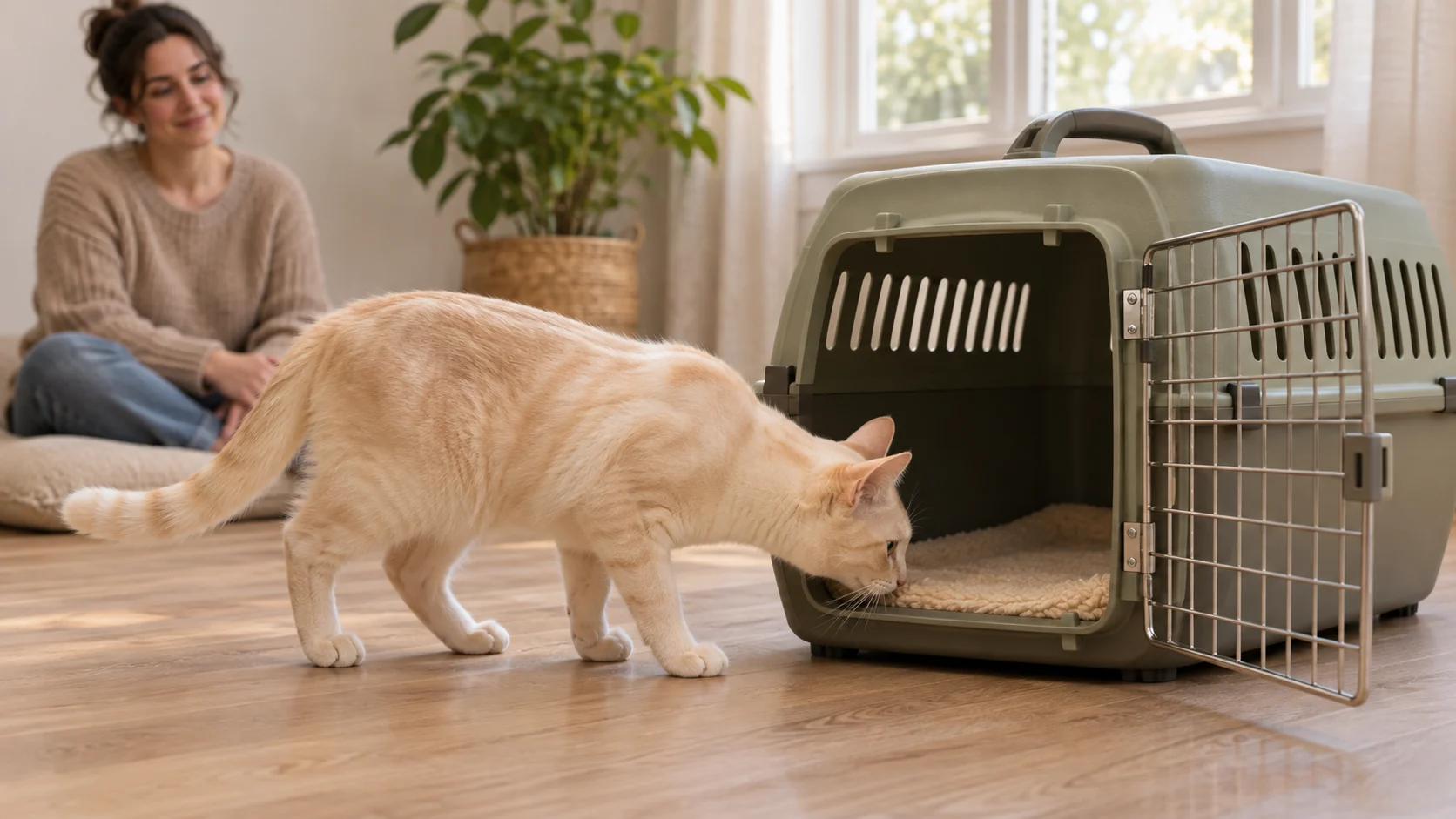
If your cat disappears as soon as you take the carrier out of the closet, the carrier may have become an early warning that a ride or a veterinary visit is coming. It can also be unfamiliar, especially if it spends most of the year out of sight. Start by leaving it open in a room your cat already uses. The first bit of progress might be walking past it as usual or taking a treat nearby.[1][2]
If the visit is soon and getting your cat into the carrier has been difficult before, call the clinic now to make a plan for that trip. You can practice at home on a separate track.[1]
Give the carrier an everyday spot
Start with the carrier you already own if it’s sturdy, well ventilated, latches securely, and gives your cat enough room to stand, turn around, and lie down comfortably. A low entrance can be easier to step through. A top opening or removable top can make it easier for the veterinary team to examine a cat who prefers to stay in the base.[1][2][3]
Set it on a stable surface in a quiet spot with a clear path in and out. Add a familiar towel that lies flat and secure the door open so it can’t swing as your cat passes. Leave the usual hiding and resting places available, including any boxes your cat already uses as retreats.[1][2]
Practice one change at a time
Start where your cat can notice the carrier and still move normally. If your cat likes treats and can have them, offer a small piece at that distance. Keep regular meals in their usual spot. Over short practices, move the reward closer only if your cat keeps choosing to approach. Keep the exit clear, including after your cat takes the reward.[1][3]
The examples below give you a starting point for the door and the first lift. Stay with a step while your cat is getting used to it.[4]
| What your cat does comfortably | One small change to try |
|---|---|
| Approaches the open carrier | Offer a reward at the entrance. Give your cat room to step away. |
| Steps inside and leaves easily | Move the door a little, then swing it open again. Practice a brief close and reopen on a later try if small movements are uneventful. |
| Remains relaxed during a brief closure | Check the latch and carrier fasteners, support the base, and lift slightly. Set it down and open it in the same quiet room. Add a few indoor steps only when the lift is easy. |
Look at how your cat moves before and after each change. A cat who sniffs, turns easily, or comes back on their own may be ready to repeat the step. If your cat flattens their ears, freezes, backs away, or tries to escape, end the attempt. If the door is closed, set the carrier down and open it in the secure room. Next time, return to a step your cat handled comfortably. A still cat can be frightened, even if they took a treat moments earlier.[3]
A small randomized study of 22 cats found that cats given carrier and travel practice had a larger drop in observed stress scores on a 10-minute car ride than the comparison group. The study used a mock clinic and a six-week training program. Its results support practicing, but the study schedule doesn’t tell you how long your cat will need.[5]
When the appointment is close
Tell the veterinary team where the problem starts. Does your cat hide when they see the carrier, struggle when lifted, or drool or vomit during the ride? Those details help the team plan for fear, pain, or possible motion sickness. Ask for help with loading and whether your cat needs a pre-visit plan. Mention any sudden resistance to being picked up, even when the carrier is out of sight. Follow the clinic’s feeding and medication instructions for that appointment.[1][3]
Once your cat is safely inside, check the latch and support the base so the carrier stays level. Secure it in the vehicle. FelineVMA recommends securing the carrier on the floor behind a front seat. Use a seat belt only with a crash-test-certified carrier designed for that setup, and follow its instructions. Keep the carrier closed until the veterinary team is ready in a secure room.[2][6]
Get veterinary care right away if your cat is struggling to breathe. If you’re having trouble getting a sick or injured cat into the carrier, contact the clinic or emergency hospital immediately for transport guidance. Practice can wait until the immediate health concern is addressed.[7]
A CURIOUS LOOK AT LIFE WITH PETS
Continue
Exploring.
Keep following your curiosity.
There’s more to discover.
Why Do Cats Love Boxes? What Research Can and Can’t Explain
Explore what boxes can offer as retreats and enrichment.
Explore the article
How to Keep an Indoor Cat Entertained Without Overwhelming Them
Build manageable play, exploration, and resting opportunities.
TRAVEL & CAREHow to Road Trip With Your Dog or Cat: What to Pack, When to Stop, and Where They’ll Sleep
Set up the car, plan safe stops, and pack for the first night.
Sources
- American Animal Hospital Association. Helping your cat cope with veterinary visits. 2026.
- Feline Veterinary Medical Association. Getting your cat to the veterinarian.
- Rodan I, et al. AAFP/ISFM Cat Friendly Veterinary Interaction Guidelines. Journal of Feline Medicine and Surgery. 2022.
- Feline Veterinary Medical Association. Visiting Your Veterinarian: Getting Your Cat to the Veterinary Practice. Caregiver brochure.
- Pratsch L, et al. Carrier training cats reduces stress on transport to a veterinary practice. Applied Animal Behaviour Science. 2018. Publisher abstract.
- Feline Veterinary Medical Association. Transportation of Cats in Motor Vehicles. 2025 position statement.
- Cornell Feline Health Center. Dyspnea (Difficulty Breathing).